🚀 Top Programming Languages of Late 2025: Mojo, Rust & MoonBit Rise
“High-performance code for the modern AI & web era.”
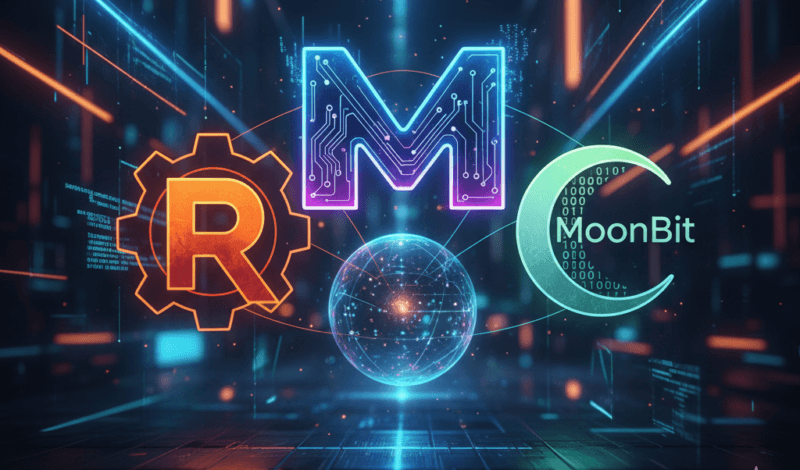
As we approach the end of 2025, three programming languages are gaining serious momentum — Mojo, Rust, and MoonBit. Each brings something unique to the table: from systems-level speed to safe concurrency to WebAssembly-first design.
For developers, students, and clients building AI-driven apps or high-scale web systems, learning any of these languages now could be a game-changer. Let’s dive in.
🧠 Why These Languages Matter in Late 2025
Mojo
Created by Modular Inc., Mojo blends Python’s ease of use with systems-level performance (multi-hardware via MLIR).
Why developers care: If you know Python, you can pick up Mojo quickly. Then you get C++/GPU-level speed when you need it. A single language for prototyping and production.
🧪 Mojo: The Next-Gen Language for AI & ML-Driven Systems
That’s where Mojo, developed by Modular Inc., steps in — a new programming language that could redefine how we build and run AI systems.
👉 Learn MoreRust
Rust continues to shine thanks to its memory safety, concurrency model, and performance. Ideal when you need safe, high-performance back-end systems or native modules.
MoonBit
MoonBit is built for WebAssembly, edge/cloud, and AI-native code — combining functional, static, and dynamic features. moonbitlang.com+1
Why it matters: When you target both browser/edge and server with one language, MoonBit offers a unified path.
🛠 How These Languages Compare: Which to Learn First?
| Language | Key Strength | Best For Students/Developers | Considerations |
|---|---|---|---|
| Mojo | Python-style syntax + GPU/accelerator power | AI/ML prototypes → high performance apps | Ecosystem still maturing |
| Rust | Safe concurrency + systems-level speed | Native modules, backend services, performance-critical apps | Steep learning curve |
| MoonBit | WebAssembly/edge + AI-friendly toolchain | Full-stack (front + edge + backend) using one language | Very new, smaller community |
📚 How Developers & Students Can Use These Languages
Mojo
- Prototype a machine-learning model using familiar Python-style code.
- Then compile the same logic for GPU or accelerator hardware without rewriting.
- Use it in production for AI-powered dashboards, data pipelines, or compute kernels.
Rust
- Build high-performance microservices or WebAssembly modules for the browser.
- Use its memory safety to build reliable, concurrent systems (e.g., real-time analytics).
- Combine Rust with other languages (e.g., via FFI) for performance-critical parts.
MoonBit
- Develop web apps or edge functions with one language targeting WASM and server.
- Use built-in AI-friendly constructs to automate testing, documentation, code generation.
- Ideal for students learning full-stack and newer platforms.
📊 Real Use Case: How Mystic Matrix Implements Mojo, Rust & MoonBit
At Mystic Matrix Technologies, we’re embracing the future by using Mojo to power next-gen applications that blend AI intelligence with real-time performance. This language isn’t just for experiments — it’s practical, powerful, and ready for production.
🚀 1️⃣ AI Chatbot — Smarter Conversations, Lightning Speed
We’re developing an AI assistant built entirely with Mojo, designed to seamlessly integrate into websites, learning platforms, and business dashboards.
Thanks to Mojo’s Python-like syntax, developers can easily write conversational logic — but behind the scenes, its MLIR-powered engine runs high-speed AI inference that delivers instant responses and low-latency interactions.
💡 Think of it as building a ChatGPT-style assistant — but optimized for your own app, running with near-C++ performance.
🧠 2️⃣ AI-Driven Grid Dashboard — Intelligent Data, Visualized
Our upcoming AI-powered Grid Dashboard lets teams drag, drop, and manage their entire workflow in one place — from analytics to automation.
Here, Mojo handles the heavy lifting — GPU computations, data processing, and smart predictions — while the frontend remains smooth and interactive.
🔥 The result? A dashboard that thinks, predicts, and performs faster than anything built with traditional scripting languages.
💻 Build Your Own App Using Mojo
Mojo opens the door for developers and students to create high-performance apps without needing to master C++ or Rust. You can:
- 🧩 Prototype AI tools using familiar Python-style syntax
- ⚡ Accelerate data pipelines with GPU and parallel processing
- 🧠 Develop chatbots, dashboards, and even compilers
- 🌐 Integrate AI directly into full-stack projects with WebAssembly support
With Mojo, you don’t just code — you engineer intelligence.
At Mystic Matrix, we’re already exploring how these innovations can empower both students learning AI and clients building scalable, smart applications.
🔧 Bottom Line
If you’re a student or developer looking to level up in late 2025, focus on Mojo, Rust, and MoonBit.
These languages aren’t just trends — they represent the future of high-performance, AI-driven, and full-stack development.
Pick one, build something real, and you’ll be ready for the next wave of tech.
❓ Frequently Asked Questions (FAQ)
Mojo is a natural step — the syntax is familiar, and you’ll gain performance benefits quickly.
Absolutely — Rust’s mix of safety and speed makes it ideal for systems that matter (back-end, embedded, WASM). You’ll future-proof your list of skills.
Not quite yet — but it offers a promising path: one language across front-end, edge, and backend with built-in AI tooling. For students exploring full-stack & WASM, it’s worth keeping an eye on.
Yes — especially for Mojo and Rust. The job market for high-performance AI and systems work is growing. MoonBit is early, but early adopters gain advantage.
Modern projects often combine strengths: use Rust for core performance modules, Mojo for AI/ML logic, and MoonBit for deploying WebAssembly apps to the browser. Together, they enable full-stack innovation, ensuring speed, safety, and scalability across devices.