🎭 TOON vs JSON
“A new challenger enters the world of structured data.”
For years, JSON has been the backbone of web APIs, app configurations, microservices communication, and modern backend systems. It changed how the web stores and exchanges information — simple, readable, lightweight.
But as AI systems advance and new formats emerge, developers are exploring alternatives that solve JSON’s limitations. One such rising format is TOON — a modern, flexible, expressive data structure built with AI workflows and rich context in mind.
So how does TOON compare to JSON? And more importantly — which one should YOU use?
Let’s break it down.
🧠 What Is JSON?
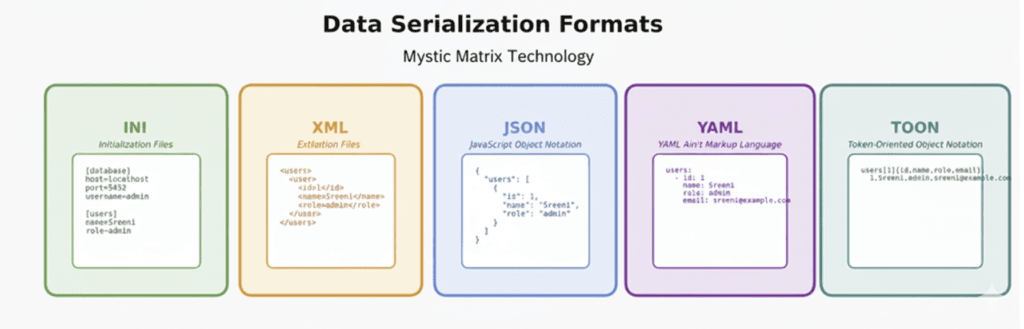
JSON, short for JavaScript Object Notation, is one of the most widely used data formats ever created. For over two decades, it has powered the backbone of APIs, databases, configuration files, system logs, and modern web applications. At its core, JSON stores information using simple structures such as objects, arrays, strings, booleans, and numbers. Because of its simplicity and readability, developers across every language — JavaScript, Python, Java, C#, Go, Rust, PHP — embraced it as the universal standard for exchanging data. JSON’s strength comes from its elegant key–value model, which makes it easy for both humans and machines to understand. Whether fetching a user profile from an API or configuring a cloud service, JSON provides a lightweight and flexible foundation.
JSON became the default because it hit the perfect balance between simplicity and functionality. It required no special tooling, no complex syntax, and no learning curve. Developers could open a JSON file and immediately understand its structure. Its ubiquity in browsers and Node.js accelerated its dominance, making it deeply embedded in the modern internet. APIs like REST, GraphQL responses, MongoDB documents, and countless webhooks rely on JSON’s intuitive structure. The format is also efficient, transferable, and easy to parse — which made it ideal for small to medium datasets that don’t require advanced relational context.
However, JSON has clear limitations that have become increasingly obvious in the age of AI, automation, and multi-agent systems. JSON struggles to represent deeply nested relationships without becoming messy and hard to maintain. It has no built-in support for metadata, meaning developers often rely on awkward naming conventions or external schemas to add context. JSON does not naturally support semantic tagging, version awareness, or evolving schema definitions — all of which are critical for AI-driven infrastructures. As AI systems handle larger datasets with complex relationships, JSON becomes insufficient to express the deep contextual meaning these models require.
The format that was perfect for traditional applications now faces challenges in an AI-first world where data is dynamic, interconnected, and semantically rich. This is exactly where TOON begins to shine.
🧬 What Is TOON?
The Next-Gen Data Format Designed for AI & Autonomous Systems
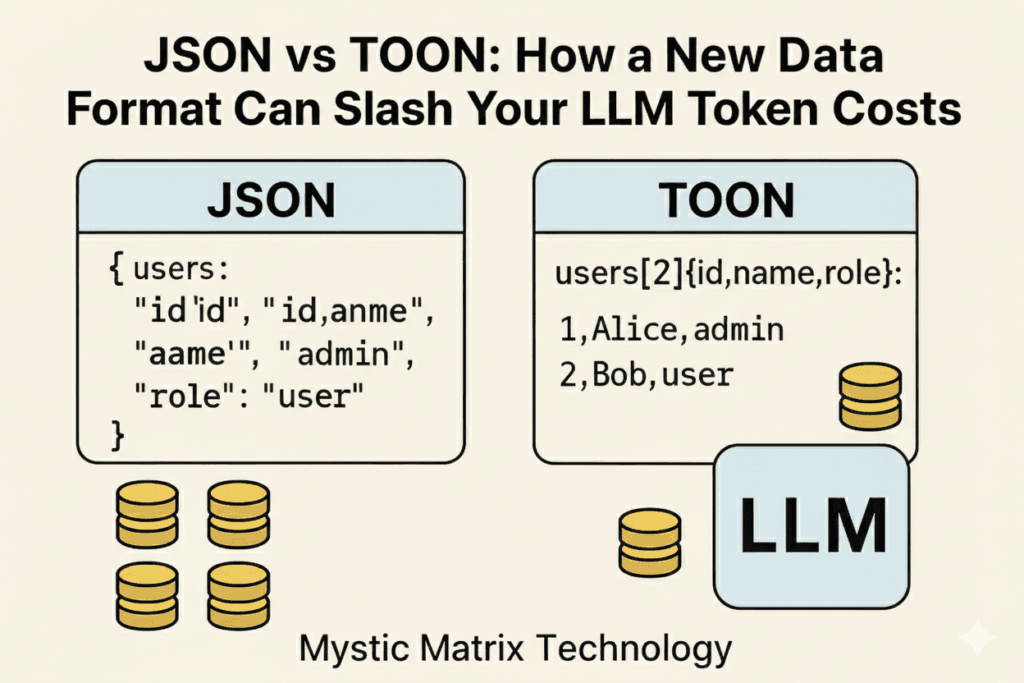
TOON is an emerging data format engineered specifically for the modern era of AI, multi-modal systems, and autonomous agents. While JSON was made for the web, TOON is made for intelligence. It is structured not only to store information, but to explain relationships, maintain context, and adapt as systems evolve. TOON is designed to carry richer metadata and deeper meaning, allowing AI models to interpret data more naturally — the way they understand embeddings, semantic links, and hierarchical structure.
Unlike JSON, which focuses on storing static values, TOON emphasizes contextual representation. It supports hierarchical structures that model real-world relationships, much like how knowledge graphs store semantic meaning. A TOON file can contain not only raw data, but the purpose behind the data, historical context, relationships between entities, versioning details, and task intentions. This makes TOON extremely powerful for AI workflows that require reasoning rather than simple data retrieval.
TOON also introduces the concept of version-aware schemas. This means data structures can evolve without breaking older models or workflows, allowing AI agents to adapt in real time. It supports semantic tagging, enabling richer meaning inside the file—something JSON cannot naturally express without workaround conventions. TOON is built to handle multi-agent ecosystems where different AI agents need to collaborate, share memory, and understand the same dataset from different perspectives. Instead of squeezing contextual meaning into poorly named JSON fields, TOON allows these insights to live naturally in the structure.
For AI developers, TOON provides cleaner, more interpretable data that reduces hallucinations and improves reasoning accuracy. For automation engineers, TOON becomes the ideal backbone for storing task definitions, user intent, decision trees, and workflow metadata. For businesses, it provides a scalable, structured way to manage AI interactions, RAG memory, behavioral logs, user embeddings, and agent coordination.
TOON is not just a data format — it is the evolution of how intelligent systems communicate. Where JSON gives structure, TOON gives understanding. Where JSON stores facts, TOON stores meaning. And in the era of autonomous agents, contextual memory, and AI-driven decision-making, meaning is everything.
📊 Comparison Table
| Feature | JSON | TOON |
|---|---|---|
| Human Readability | ⭐⭐⭐⭐ | ⭐⭐⭐⭐⭐ |
| AI Compatibility | ⭐⭐⭐ | ⭐⭐⭐⭐⭐ |
| Schema Evolution | ⭐⭐⭐ | ⭐⭐⭐⭐⭐ |
| Metadata Support | ⭐⭐ | ⭐⭐⭐⭐⭐ |
| Nested Structures | Can become complex | Designed for deeply structured data |
| Best For | APIs, configs | AI pipelines, agent memory, semantic data |
🆚 TypeScript vs Python
This blog breaks down the strengths, weaknesses, and use-cases for AI, web development, and automation to help students, developers, and businesses decide which language fits their goals best.
👉 Learn More⚔️ TOON vs JSON: A Deep, Modern Comparison
1️⃣ Readability & Structure
How Clearly Can Humans & AI Understand the Data?
JSON has always been loved for its simplicity, but its readability quickly declines as complexity grows. A few nested objects are fine — but once you start dealing with multi-layered APIs, relationships, or deeply structured documents, JSON becomes visually cluttered and harder to maintain. Developers often struggle with long, nested structures, trailing commas, inconsistent indentation, and the lack of semantic meaning. JSON reads like raw data, not like a conceptual model. This creates friction when scaling applications or when teams need to collaborate across large codebases.
TOON, on the other hand, is designed from the ground up for clarity, context, and AI-assisted understanding. Its structure is more expressive, meaning that relationships, metadata, and hierarchical meaning are readable at a glance. TOON aims to make data not only human-readable, but AI-native. This means AI agents can interpret the structure more accurately without pre-processing or guesswork. TOON reads like a blend of structured data and semantic explanation, making it much more intuitive for large teams, AI systems, and multi-agent workflows.
Key Improvements in TOON:
- Cleaner hierarchy representation
- Expressive structures that reduce ambiguity
- Designed for both human readability and AI reasoning
- Easier debugging in large-scale systems
- Reduced cognitive load when mapping data to logic
TOON achieves what JSON cannot: a readable structure that scales with complexity instead of collapsing under it.
2️⃣ Schema Flexibility
How Well Does the Format Adapt as Data Evolves?
JSON has a fixed schema approach. Once you define a structure, modifying it at scale becomes dangerous. Adding or removing fields can break clients, older services, or existing workflows. Developers must maintain backward compatibility through manual checks, versioning hacks, or middleware transformations. JSON was never designed for rapidly evolving systems — especially not AI-powered environments where data changes constantly.
TOON embraces dynamic and evolving schemas. It supports version-aware definitions that allow data structures to grow organically without breaking older workflows. This is incredibly valuable in AI-driven automation, where models, agents, and contexts evolve frequently. TOON makes it possible to introduce new fields, update existing ones, or restructure relationships without breaking downstream consumers.
Why TOON Wins in Schema Flexibility:
- Built-in version awareness
- Self-describing schemas that evolve safely
- Backward and forward compatibility
- Ideal for long-term AI agent memory
- Reduces maintenance overhead and refactoring
TOON operates like a living schema system designed for growth — JSON remains static and brittle in comparison.
3️⃣ Metadata Support
Does the Format Understand Labels, Meaning, or Context?
JSON has no native support for metadata. Developers must manually embed extra fields like _meta, info, tags, or description, leading to inconsistent patterns across systems. This causes fragmentation, confusion, and additional documentation overhead. JSON simply stores values — it does not describe them.
TOON treats metadata as a first-class citizen. Every value, object, or relationship can include purpose-based tags, labels, semantic descriptions, version hints, and contextual information. This helps AI agents reason more effectively and reduces hallucinations in RAG or autonomous workflows. Metadata is structured, expressive, and designed to integrate naturally.
What TOON Does Better:
- Built-in metadata fields
- Semantic tagging improves AI reasoning
- Contextual relationships embedded directly
- Perfect for knowledge graphs and agent cooperation
- Removes ambiguity about data meaning
TOON transforms plain data into understandable knowledge, something JSON cannot achieve without complex conventions.
4️⃣ Context Awareness
Can the Format Represent Meaning, Not Just Structure?
JSON is unaware of meaning. A user object and a product object look identical structurally. JSON does not encode relationships, behaviors, or semantic properties. For AI systems that rely heavily on context, this forces developers to create additional layers, adapters, and mapping systems — slowing down development and increasing latency in decision-making pipelines.
TOON is context-first. It encodes relationships, dependency chains, intent, and entity types directly within the structure. For AI workflows such as Retrieval-Augmented Generation (RAG), autonomous agents, or multimodal reasoning systems, TOON becomes dramatically more useful. AI can interpret relationships without requiring manual mapping or transformation. This reduces errors, speeds up inference, and enables far more complex automation.
TOON’s Context Superpowers:
- Understandable hierarchical meaning
- Entity-to-entity relationship encoding
- Perfect for AI reasoning and RAG
- Supports multi-agent collaboration
- Minimizes model hallucinations due to missing context
TOON behaves more like a knowledge graph, while JSON behaves like static storage.
5️⃣ Performance in AI & ML Workloads
Which Format Performs Better for Modern AI Pipelines?
JSON requires additional parsing, normalization, and transformation before AI systems can use it effectively. It lacks semantic richness, forcing developers to write custom interpreters to extract meaning. Large JSON datasets become slow to process, difficult to index in vector databases, and inefficient in multi-agent environments.
TOON is optimized for AI-native performance. By embedding meaning, metadata, and relationships directly into the structure, TOON reduces pre-processing time significantly. It integrates more smoothly with vector stores, improves embedding accuracy, and accelerates retrieval tasks. In multi-agent systems, TOON allows agents to extract structured knowledge without extra translation layers, improving both speed and reliability.
Performance Advantages of TOON:
- Faster parsing for AI pipelines
- Higher-quality embeddings due to rich context
- More efficient retrieval for RAG
- Reduced preprocessing requirements
- Scales better with complex datasets
In an AI-first world, TOON becomes the natural choice for systems that require speed and intelligence.
🛠 Use Cases
1️⃣ When JSON Works Best
The Lightweight Champion for Traditional Web Development
JSON excels in environments where speed, simplicity, and universal compatibility matter more than semantic depth. It is the backbone of REST APIs, configuration files, microservices, mobile communication, and lightweight IoT systems. JSON’s structure — simple key-value mappings — makes it easy for developers to read, debug, and integrate across any programming language. It thrives in ecosystems where humans and machines both benefit from predictable, minimal overhead.
For REST APIs, JSON remains unmatched because it provides clear, human-readable payloads that serialize and deserialize with minimal processing. Most web applications, frontend frameworks, and mobile apps rely heavily on JSON because it’s lightweight and well-supported across JavaScript, Python, Ruby, Go, Swift, and Java ecosystems. JSON keeps systems simple and fast, especially when data structures do not require rich hierarchical metadata or semantic relationships.
In microservices communication, JSON ensures consistent and reliable message passing between distributed components. It integrates seamlessly with event buses, message queues, and API gateways, making it ideal for scalable cloud-native architectures. Even in IoT, where devices often have limited compute and memory, JSON offers a minimal overhead solution for exchanging state information, telemetry, and commands.
JSON also remains the go-to choice for small datasets, config files, environment variables, and quick data serialization. Because of its simplicity, teams can iterate faster without complex schemas or heavy tooling. In environments where complexity must stay low, JSON continues to shine.
JSON is perfect when your system needs:
- Minimal processing overhead
- Human-friendly, direct syntax
- Fast web communication
- Compatibility across all languages
- Simple data without semantic depth
- Reliability in small or medium-scale applications
JSON still dominates the traditional web stack — because not every system requires the intelligence demanded by modern AI workloads.
2️⃣ When TOON Works Best
The AI-Native Format for Intelligent Systems & Context-Aware Workflows
TOON enters the picture when systems need deep context, semantic relationships, evolving schemas, and intelligent interpretation. Unlike JSON, TOON is not just a container for data — it is a framework for meaning. Designed specifically for AI and autonomous agent ecosystems, TOON supports knowledge-rich structures that enable reasoning, long-term memory, and multi-modal integration.
In the world of AI agents, TOON is transformative. Agents need contextual understanding — not just raw values — to perform multi-step actions, collaborate with other agents, generate reasoning chains, or resolve ambiguous instructions. TOON embeds metadata and semantic tags that describe not only what a value is, but why it matters, how it connects to others, and how it should be interpreted in future tasks. JSON cannot offer this depth without manual workarounds.
For RAG (Retrieval-Augmented Generation) pipelines, TOON enables enhanced retrieval precision because its structure mirrors how vector databases interpret information. With richer metadata and hierarchical relationships, embeddings become more accurate, enabling models like GPT-4, Llama 3, and Claude to produce grounded, context-aware responses. TOON reduces hallucinations because it provides meaning within the data itself rather than relying on external interpretation layers.
TOON also excels in multi-modal environments involving images, text, audio, structured metadata, or agent-generated notes. AI systems trained on multi-modal knowledge require flexible data schemas that evolve without breaking — something JSON struggles with due to its rigid, static structure. TOON’s version-aware schema system makes it perfect for enterprise knowledge graphs, computer vision workflows, robotics pipelines, and semantic AI workloads.
Large enterprises, universities, research labs, and automation-heavy businesses increasingly embrace TOON for workflow orchestration. When agents autonomously manage tasks, track operational state, communicate intent, and store long-term knowledge, TOON becomes the natural data foundation.
TOON is ideal when your system needs:
- AI-native data understanding
- Hierarchical meaning, not just key-value pairs
- Multi-agent cooperation
- Rich metadata & semantic tags
- Evolving schemas without breaking changes
- Large datasets requiring contextual depth
- Multi-modal AI pipelines
- Enterprise knowledge graphs or workflow automation
TOON is not replacing JSON — it’s expanding what data formats can do in an AI-first world.
🎓 How Students, Developers & Businesses Benefit from TOON
Personalized, AI-ready data formats like TOON are not just innovations — they are becoming essential tools for students, developers, and modern businesses. As AI workflows grow more complex, the limitations of classical data formats like JSON become more visible. TOON fills this gap by offering structure, meaning, and semantic clarity that align perfectly with how modern AI systems operate. Here’s how each audience benefits profoundly from this shift.
⭐ 1. How Students Benefit from TOON
A Beginner-Friendly Gateway Into AI Data Modeling & Intelligent Systems
For students, TOON is more than a data format — it’s a learning tool that bridges the gap between simple programming and advanced AI systems. JSON teaches basic structure, but TOON teaches context, relational mapping, and reasoning, giving students a hands-on understanding of how AI systems interpret data beyond simple key-value pairs. This prepares them for a future where data needs to be meaningful, not just structured.
Students experimenting with AI-powered apps — such as chatbots, study assistants, RAG-based research tools, or autonomous agent projects — quickly realize that JSON becomes messy and limiting as complexity increases. TOON, however, provides a cleaner representation of intentions, state changes, user memory, and contextual metadata, making it much easier to architect projects that “scale in intelligence” rather than just functionality.
TOON also helps beginners understand concepts like embeddings, ontology, semantic tagging, and knowledge graphs without diving into overwhelming theory. Because the format mirrors how AI models think — through relationships and context — students gain early exposure to the mechanics of AI reasoning. This gives them a competitive edge when entering fields like machine learning, data engineering, or agent-based automation.
Whether building school projects, portfolio apps, or early-stage startups, students benefit from a more expressive foundation that simplifies advanced concepts they would otherwise struggle to grasp. TOON lowers complexity while raising the sophistication of what they can build.
⭐ 2. How Developers Benefit from TOON
A Smarter Alternative for Modern Architecture, AI Integration & Scalable Systems
Professional developers quickly recognize that TOON solves several long-standing problems in software engineering. JSON works for simple APIs, but as systems expand into multi-agent workflows, event-based automation, personalization engines, and AI memory storage, managing data relationships becomes painful. TOON eliminates these pain points by offering a built-in semantic layer.
Developers no longer need to write extra layers of interpretation code to explain meaning, context, or relationships between data entries — TOON encodes this directly. This drastically reduces boilerplate, improves maintainability, and makes architecture far more predictable.
When integrating with vector databases like Pinecone, Weaviate, FAISS, Vespa, or RAG frameworks such as LangChain, LlamaIndex, OpenAI Assistants, developers see immediate benefits. TOON aligns perfectly with embedding-based retrieval, storing not only text but the intent and context surrounding it. This results in fewer hallucinations, better grounding, and more accurate AI responses.
Developers working with AI agents — especially using tools like CrewAI, AutoGPT, LangGraph, or Multi-Agent orchestrators — appreciate how TOON makes agent memory and communication more natural. Instead of passing unstructured JSON blobs back and forth, agents can exchange rich, descriptive, and reliable data structures that preserve meaning.
The bottom line: developers get cleaner code, fewer bugs, more clarity, and faster AI integration.
⭐ 3. How Businesses Benefit from TOON
Smarter Data, Stronger AI Outcomes, and Scalable Automation at Enterprise Levels
Businesses adopting AI face one major challenge: data fragmentation. Information scattered across spreadsheets, dashboards, APIs, emails, and outdated systems prevents AI from performing optimally. JSON only stores fragments of this information; TOON stores knowledge in a way that AI can actually use.
With TOON, companies gain structured intelligence — a living data format that grows with their workflows, products, users, departments, and automation systems. AI-driven insights become more accurate because the model has access not just to raw data, but to context-rich representations. This reduces hallucinations, improves decision-making, and makes AI automation more reliable.
Businesses using multi-agent systems (customer support agents, analytics agents, DevOps agents, finance agents) rely on TOON to synchronize knowledge across their digital workforce. TOON becomes the “brain language” that keeps AI agents aligned, consistent, and up-to-date, something JSON is too simplistic to support at scale.
For enterprise-level knowledge graphs, process automation, and personalized customer experiences, TOON provides a flexible schema that evolves without breaking. This dramatically reduces operational costs, speeds up AI deployment, enhances consistency, and provides long-term stability in AI-enabled products.
❓ Frequently Asked Questions (FAQ)
TOON is designed for AI-first workloads, meaning it stores context, relationships, metadata, and semantic meaning, while JSON only stores raw key–value data. TOON is ideal for AI agents, RAG systems, and multi-modal workflows, whereas JSON is best for simple APIs and lightweight applications.
Not entirely. JSON will continue to dominate traditional web development and API communication because it is simple, universal, and fast. TOON will complement JSON by powering AI-heavy, context-driven, and multi-agent applications where JSON falls short.
Industries using large datasets, AI workflows, and semantic search — such as healthcare, finance, education, e-commerce, automation, and enterprise dashboards — benefit most. TOON improves accuracy, reduces hallucinations, and enables smarter AI reasoning.
TOON has a slightly higher learning curve because it includes metadata, context links, and semantic structures, but its human-readable format and AI-aligned design make it easier over time. Students often find TOON helps them better understand how AI models think.
Yes — and this is the most common approach. JSON handles simple data and API communication, while TOON manages AI-specific memory, knowledge graphs, and contextual datasets. Using both provides flexibility, scalability, and future-proof architecture.