🤖 RPA + AI Explained: How Intelligent Automation Is Transforming Businesses in 2026
From task automation to decision intelligence.
Automation is no longer just about speed—it’s about intelligence. As we move into 2026, businesses are rapidly shifting from traditional Robotic Process Automation (RPA) to RPA combined with Artificial Intelligence, often referred to as Intelligent Automation.
This evolution marks a fundamental change in how organizations operate. Instead of automating only repetitive, rule-based tasks, companies are now building systems that understand context, learn from data, make decisions, and adapt over time.
In this blog, we’ll explain what RPA + AI really means, how it works, why it’s accelerating in 2026, and how it’s reshaping operations across industries.
🧠 What Is RPA + AI?
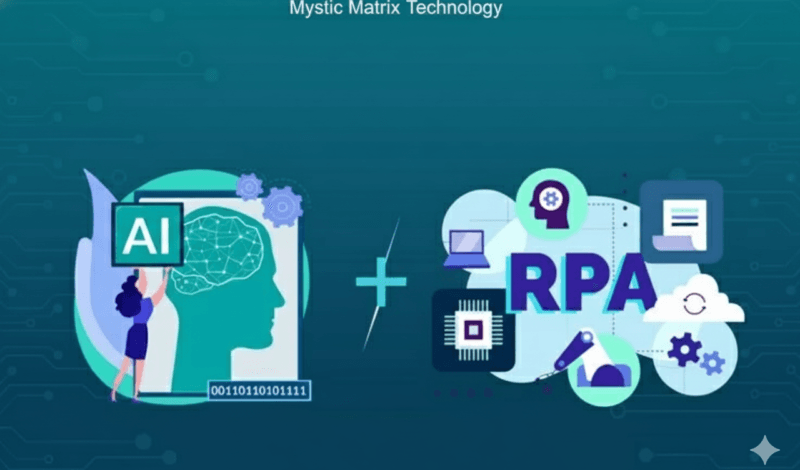
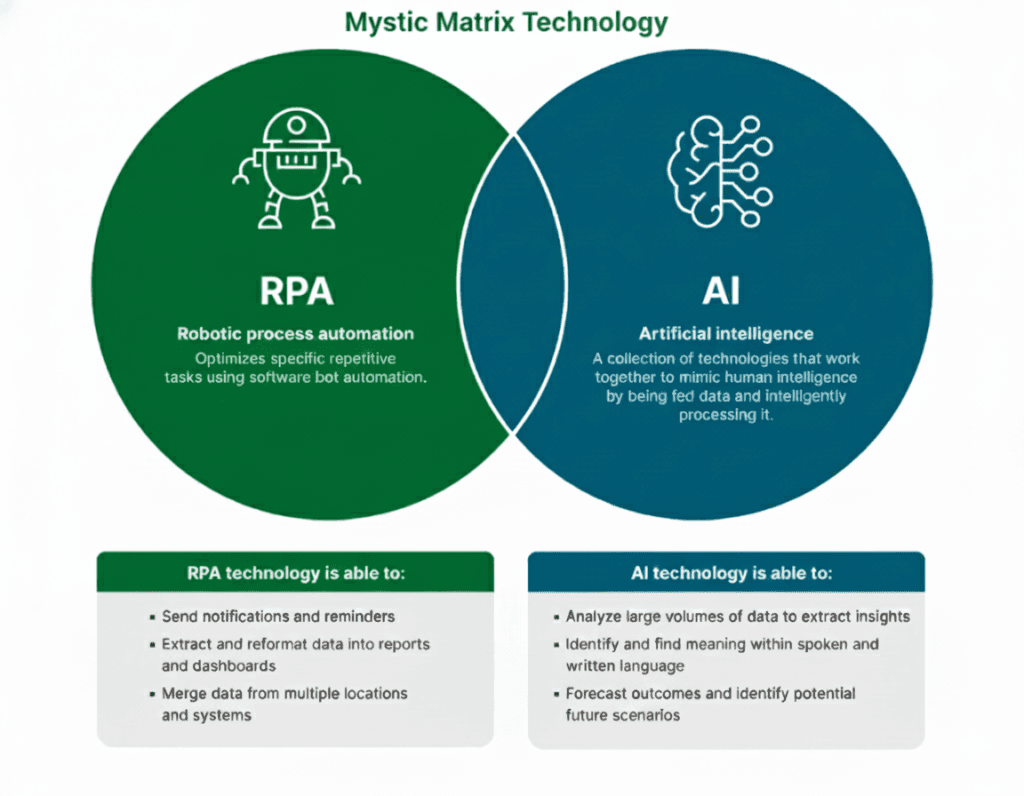
RPA + AI represents the next evolutionary stage of business automation, combining the execution strength of Robotic Process Automation (RPA) with the cognitive capabilities of Artificial Intelligence (AI). At its foundation, RPA uses software bots to replicate repetitive human actions—such as logging into applications, moving data between systems, triggering workflows, and following predefined rules with high speed and accuracy. AI, on the other hand, brings the ability to understand, learn, reason, and adapt using technologies like machine learning, natural language processing (NLP), computer vision, and large language models (LLMs). When these two domains converge, automation shifts from rigid task execution to intelligent, context-aware decision-making.
Traditional RPA has proven extremely effective for structured, predictable processes—think invoice posting, report generation, account reconciliation, or system synchronization. However, modern businesses rarely operate in perfectly structured environments. Emails arrive in free-form language, documents vary in format, exceptions occur frequently, and decisions often require interpretation rather than simple rule matching. In such scenarios, pure RPA breaks down, requiring constant maintenance, rule updates, and human intervention. This limitation is precisely where AI becomes transformative.
AI enables RPA systems to process unstructured and semi-structured data, such as PDFs, scanned documents, emails, chat messages, voice transcripts, and images. With AI embedded into automation workflows, bots can now read and understand documents instead of just extracting text, interpret intent from customer messages, classify and prioritize requests, detect anomalies, and make probabilistic decisions based on historical data. Rather than failing when conditions change, AI-powered bots can adapt, learn from outcomes, and continuously improve performance over time.
The most important shift introduced by RPA + AI is philosophical as much as technical. Automation is no longer limited to the instruction “do exactly this when X happens.” Instead, it evolves into “understand the situation, decide the best action, and execute it responsibly.” Bots can explain why a decision was made, flag uncertainty, escalate edge cases to humans, and operate within defined governance boundaries. This creates automation systems that are not only faster, but also smarter, safer, and more trustworthy.
By 2026, RPA + AI is less about deploying isolated bots and more about building autonomous, end-to-end business systems. These systems orchestrate entire workflows across departments—finance, HR, operations, customer support—while continuously learning from data and feedback. Human teams shift from managing tasks to supervising outcomes, setting policies, and focusing on strategic work. In this new paradigm, automation is no longer a back-office efficiency tool; it becomes a core driver of scalability, resilience, and competitive advantage.
Key Points at a Glance
- RPA + AI combines execution (RPA) with intelligence (AI)
- Moves automation from rule-based tasks to context-aware decision-making
- Enables handling of unstructured data like emails, documents, and images
- Reduces fragility and maintenance compared to traditional RPA
- Supports learning, adaptation, and continuous improvement
- Powers autonomous, end-to-end business processes in 2026
- Shifts human roles from task execution to strategic oversight
✨ Why RPA Alone Is No Longer Enough
Robotic Process Automation was a significant breakthrough when it first entered the enterprise landscape. It allowed organizations to automate repetitive, rule-based tasks at a scale and speed that humans could not match. For processes that were stable, structured, and predictable, RPA delivered immediate value—reducing manual effort, lowering operational costs, and improving consistency. However, RPA was never designed to handle the complexity, ambiguity, and constant change that define modern digital businesses. As organizations pushed automation deeper into core operations, the limitations of standalone RPA became increasingly apparent.
One of the biggest challenges with traditional RPA is process fragility. Rule-based bots depend on rigid logic and predefined conditions. Even small changes—such as a modified user interface, a new data field, or a slight variation in workflow—can cause bots to fail. As business processes evolve due to regulatory changes, system upgrades, or market demands, RPA scripts require constant updates. This creates a maintenance burden that often offsets the initial efficiency gains and makes large-scale automation difficult to sustain over time.
Another critical limitation is RPA’s inability to work effectively with unstructured and semi-structured data. Modern enterprises handle massive volumes of emails, PDFs, scanned documents, chat messages, and free-text inputs. Traditional RPA tools can only process such data if it is first converted into structured formats, usually through manual intervention or brittle workarounds. This dependency prevents automation from scaling into customer-facing and decision-heavy workflows, where data rarely follows strict patterns.
RPA also struggles with exception handling and decision-making. Rule-based bots excel when every scenario is known in advance, but real-world operations are filled with edge cases and uncertainty. When unexpected situations arise—such as missing information, conflicting data, or ambiguous requests—RPA bots either fail silently or escalate to humans without context. This breaks end-to-end automation and forces teams back into reactive, manual problem-solving.
As automation footprints expand, organizations often encounter rule sprawl—a growing web of interdependent rules that becomes increasingly difficult to manage, test, and audit. Changes in one rule can have unintended consequences elsewhere, increasing operational risk. Over time, automation systems become fragile, opaque, and costly to maintain, limiting their long-term strategic value.
Artificial Intelligence fundamentally changes this dynamic. AI transforms RPA from a task executor into a process orchestrator. Instead of relying solely on static rules, AI-powered automation can interpret context, learn patterns from historical data, and make probabilistic decisions. Bots can understand natural language, classify documents, predict outcomes, and adapt to new scenarios without requiring constant reprogramming. Rather than breaking when conditions change, AI-enabled systems become more resilient and intelligent over time.
In modern enterprises, where workflows are dynamic and data is messy, RPA alone is no longer sufficient. AI allows automation to move upstream into complex, high-value processes—handling variability, managing exceptions intelligently, and supporting human judgment instead of replacing it. By combining RPA with AI, organizations shift from automating tasks to automating outcomes, enabling scalable, sustainable, and future-ready operations.
🔑 Key Points at a Glance
- Traditional RPA was built for stable, rule-based processes
- Rule-based bots are fragile when workflows or systems change
- RPA struggles with unstructured data like emails and documents
- Exception handling and decision-making are limited in pure RPA
- Large automation deployments suffer from high maintenance costs
- AI adds context awareness, learning, and adaptability
- RPA + AI enables resilient, end-to-end process orchestration
🔍 Core Technologies Powering RPA + AI in 2026
🧾 Intelligent Document Processing (IDP)
Intelligent Document Processing (IDP) is one of the most critical technologies driving the evolution of RPA + AI in 2026. Traditional automation systems treated documents as static files—extracting text through basic OCR and relying heavily on rigid templates. This approach worked only when document formats were consistent and predictable. However, real-world business documents rarely follow fixed structures. Invoices arrive in countless layouts, contracts vary by vendor and jurisdiction, forms change frequently, and emails mix structured data with free-flowing human language. IDP fundamentally changes how automation systems interact with this complexity.
Modern IDP systems combine advanced OCR, computer vision, natural language processing, and machine learning to move beyond text extraction and into true document understanding. Instead of simply recognizing characters on a page, AI-powered IDP identifies document intent, context, and relationships between data elements. A bot no longer sees an invoice as a collection of words—it understands what an invoice is, who issued it, what amounts matter, which dates are critical, and how the information should flow into downstream systems. This semantic understanding dramatically improves accuracy and reliability, even when documents are incomplete, poorly scanned, or formatted inconsistently.
In 2026, IDP-enabled bots can automatically classify document types without human input. Whether a file is an invoice, purchase order, contract, tax form, or customer request, the system recognizes it instantly and routes it through the correct workflow. Once classified, AI models extract key fields—such as vendor names, amounts, line items, payment terms, employee details, or compliance clauses—with high precision. These extracted values are then validated against ERP, accounting, HR, or CRM systems in real time, ensuring data integrity before any transaction is posted or approved.
One of the most powerful advancements in IDP is intelligent exception handling. When data does not match expected values—such as price mismatches, missing fields, or policy violations—AI-driven systems don’t simply fail or escalate blindly. Instead, they analyze historical patterns, assess risk levels, and decide whether the exception can be resolved automatically, routed to the appropriate team, or flagged for review with clear contextual explanations. This dramatically reduces back-and-forth communication and manual investigation.
The business impact of IDP has been transformative across departments. In finance, it accelerates invoice processing, improves close cycles, and reduces errors in payables and receivables. In HR, it automates resume parsing, onboarding documentation, and compliance paperwork. In operations and customer support, it enables faster handling of forms, claims, and service requests. What once required large teams of manual reviewers is now handled by intelligent systems that operate continuously and consistently.
Most importantly, IDP serves as the gateway technology that allows RPA + AI to scale into end-to-end automation. By unlocking unstructured data, it removes one of the biggest barriers that previously limited automation to narrow, back-office tasks. In 2026, organizations that deploy IDP effectively are not just reducing costs—they are building resilient, scalable automation foundations that can adapt as document volumes, formats, and business rules evolve.
🔑 Key Points at a Glance
- Intelligent Document Processing enables automation to understand documents, not just read text
- Combines OCR, computer vision, NLP, and machine learning
- Automatically classifies document types across formats and layouts
- Extracts and validates key data fields with high accuracy
- Handles exceptions intelligently instead of failing or escalating blindly
- Significantly reduces manual effort in finance, HR, and operations
- Acts as a foundational technology for scalable RPA + AI systems
🤖 Copilot X vs Cursor AI vs Codeium
1️⃣ GitHub Copilot X — the enterprise-grade AI deeply integrated into GitHub, built for large teams, secure workflows, and professional development environments.
2️⃣ Cursor AI — a powerful, context-aware AI IDE designed for deep multi-file reasoning, refactoring, and understanding large codebases.
3️⃣ Codeium — a fast, privacy-focused, and cost-effective AI coding assistant ideal for students, startups, and growing teams.
👉 Learn More🧩 Key Benefits of RPA + AI in 2026
The most significant benefit of RPA + AI in 2026 is the shift from automating isolated tasks to orchestrating end-to-end business processes. Traditional automation focused on individual steps—copying data, triggering actions, or moving files between systems. Intelligent automation connects these steps into cohesive workflows that span departments, systems, and decision points. From the moment data enters the organization to the point where an outcome is delivered, AI-enabled RPA systems manage the entire lifecycle with minimal human intervention. This holistic approach eliminates handoffs, reduces delays, and ensures consistency across complex operations.
Another major advantage is resilience in the face of change. Modern businesses operate in constantly evolving environments—processes change, systems are upgraded, regulations shift, and customer behavior becomes unpredictable. Rule-based automation struggles under these conditions, breaking whenever assumptions no longer hold. RPA + AI systems, however, are designed to adapt. By learning patterns, interpreting context, and handling ambiguity, intelligent automation can absorb variability without collapsing. Exceptions are no longer failures; they become manageable scenarios that the system can analyze, resolve, or escalate intelligently.
At scale, RPA + AI delivers dramatically lower operational costs while increasing output and accuracy. Intelligent bots operate continuously, handle higher volumes without linear cost increases, and reduce rework caused by human or rule-based errors. More importantly, AI reduces the hidden costs of automation—maintenance, monitoring, and manual exception handling. As automation matures, organizations spend less time fixing bots and more time optimizing outcomes, making automation economically sustainable in the long run.
RPA + AI also accelerates decision-making cycles across the enterprise. Instead of waiting for reports, approvals, or manual reviews, intelligent systems analyze data in real time and trigger actions immediately. Whether it’s approving invoices, routing customer requests, flagging risks, or forecasting outcomes, decisions happen faster and with better context. This speed is not just operational—it becomes a strategic advantage in competitive markets where timing matters.
Compliance and auditability improve significantly in AI-driven automation environments. Every action taken by an intelligent system is logged, traceable, and explainable. Policies are enforced consistently, approvals are recorded automatically, and deviations are flagged in real time. This reduces regulatory risk and simplifies audits, especially in highly regulated industries such as finance, healthcare, and insurance. Compliance shifts from being a reactive process to a built-in capability.
Equally important is the employee experience. Instead of replacing people, RPA + AI removes repetitive, frustrating work and allows employees to focus on higher-value activities—analysis, creativity, customer relationships, and strategic thinking. Teams no longer spend their days chasing exceptions or fixing errors; they supervise intelligent systems, make informed decisions, and contribute meaningfully to business outcomes. This leads to higher engagement, lower burnout, and better talent retention.
The biggest transformation, however, is cultural. In 2026, organizations no longer see automation as a mechanical executor of instructions. They trust automation to think, adapt, and collaborate. This trust reshapes how teams design processes, assign responsibilities, and measure success. Automation becomes a partner, not just a tool.
🔑 Key Points at a Glance
- Enables true end-to-end process automation
- Adapts to change instead of breaking
- Reduces operational and maintenance costs at scale
- Speeds up decision-making across the organization
- Strengthens compliance, transparency, and audit readiness
- Improves employee satisfaction and productivity
- Shifts culture toward trusting intelligent systems
🧑💻 How Developers Use RPA + AI to Become More Productive
For developers, RPA + AI in 2026 represents a powerful shift in how automation systems are built, maintained, and scaled. Instead of writing long, fragile scripts for every possible scenario, developers now design intelligent workflows where AI handles interpretation and decision-making. This drastically reduces code complexity and the need for constant rule updates. Developers focus on defining goals, constraints, and integrations, while AI manages variability and exceptions.
Modern RPA + AI platforms provide low-code and API-driven environments, allowing developers to combine traditional programming with visual workflow design. Developers can integrate AI models, call external services, connect databases, and orchestrate bots using standardized interfaces. Large language models act as reasoning engines, enabling developers to translate high-level business logic into executable automation without manually encoding every branch. This accelerates development cycles and shortens time-to-production.
Another productivity gain comes from AI-assisted development itself. Developers can use AI copilots to generate automation scripts, test workflows, debug failures, and optimize performance. Instead of spending hours diagnosing why a bot failed, AI systems can analyze logs, identify root causes, and suggest fixes. This shifts developers from reactive maintenance to proactive system design.
RPA + AI also improves collaboration between developers and business teams. Because workflows are more understandable and explainable, non-technical stakeholders can participate in defining automation logic. Developers act as enablers and architects rather than gatekeepers, reducing misalignment and rework. The result is faster delivery, better solutions, and fewer handoff issues.
By 2026, the most productive developers are not those writing the most code—but those designing adaptive, intelligent systems that evolve with the business.
🔑 Key Points at a Glance
- Reduces code complexity and rule sprawl
- Enables low-code, API-driven automation development
- Uses LLMs for reasoning and workflow orchestration
- Accelerates debugging, testing, and optimization
- Improves collaboration with business stakeholders
- Shifts developers toward architecture and strategy
🤖 What is RPA?
Robotic Process Automation (RPA), also known as software robotics, uses intelligent automation technologies to perform repetitive office tasks of human workers — such as extracting data, filling forms, moving files, and more — improving speed, accuracy, and operational efficiency.
👉 Read the Official IBM Guide🛡️ Governance, Safety & Trust
As automation becomes intelligent and autonomous, governance is no longer optional—it is foundational. AI-powered automation systems make decisions, trigger actions, and operate at scale, which means failures or misuse can have significant consequences. In 2026, successful organizations treat governance, safety, and trust as first-class features, not afterthoughts added during audits or incidents.
Modern RPA + AI platforms are built around human-in-the-loop controls, ensuring that critical decisions can be reviewed, approved, or overridden when necessary. AI systems operate within clearly defined boundaries, escalating uncertainty instead of acting recklessly. This balance allows organizations to benefit from automation speed while retaining human accountability.
Explainability is another cornerstone of trust. Intelligent automation must be able to explain why a decision was made, not just what action was taken. Explainable AI provides transparency into reasoning paths, data sources, and confidence levels. This is essential for regulatory compliance, ethical AI use, and organizational confidence—especially when automation influences financial, legal, or customer outcomes.
Strong audit trails and role-based access controls ensure that every action is traceable and authorized. Automation platforms log decisions, data changes, approvals, and exceptions automatically, creating a clear operational history. Access is tightly controlled so that users and bots can only perform actions appropriate to their roles. This reduces risk, prevents misuse, and supports compliance with internal and external regulations.
In 2026, trust is not something users hope for—it is something systems are designed to earn. Organizations that embed governance into their automation architecture can scale AI safely, responsibly, and confidently.
🔑 Key Points at a Glance
- Governance is essential for intelligent automation
- Human-in-the-loop controls balance autonomy and accountability
- Explainable AI builds transparency and confidence
- Strong audit trails support compliance and risk management
- Role-based access prevents misuse and errors
- Trust is a built-in system feature, not an afterthought
❓ Frequently Asked Questions (FAQ)
Traditional RPA automates predefined, rule-based tasks and works best in stable, structured environments. RPA + AI goes further by adding intelligence—allowing automation to understand unstructured data, handle exceptions, learn from patterns, and make context-aware decisions. This enables end-to-end process automation instead of isolated task execution.
Yes. Modern RPA + AI platforms are designed to integrate seamlessly with existing ERP, CRM, HR, and finance systems through APIs, connectors, and user interface automation. Organizations can enhance their current infrastructure without replacing core systems, making adoption faster and more cost-effective.
RPA + AI systems automatically log every action, decision, and exception with full traceability. Explainable AI ensures that decisions can be understood and justified, while role-based access and approval workflows enforce governance. This creates built-in compliance and simplifies audits, especially in regulated industries.
RPA + AI is designed to augment human work, not replace it. By handling repetitive tasks and complex data processing, intelligent automation frees employees to focus on strategic thinking, creativity, customer engagement, and decision-making. In most organizations, roles evolve rather than disappear.
Many organizations see measurable benefits within weeks when targeting high-impact use cases such as document processing or customer request automation. Broader, enterprise-wide automation is a continuous journey, but RPA + AI delivers incremental value quickly while scaling over time.