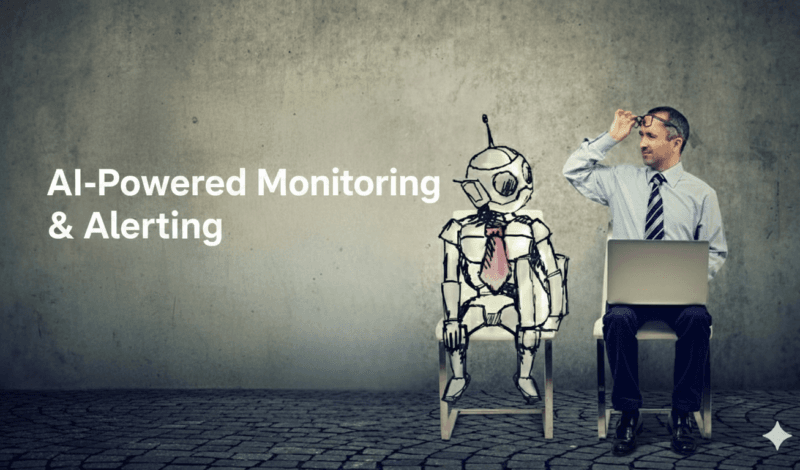
🚨 AI-Powered Monitoring & Alerting
Modern digital platforms have become faster, more distributed, and infinitely more dynamic than traditional IT systems. Cloud-native applications scale automatically, microservices communicate across complex service meshes, and workloads shift continuously across regions and providers. While infrastructure has evolved into a living, elastic ecosystem, most monitoring tools are still rooted in static, threshold-based logic that was designed decades ago for predictable, centralized environments. This mismatch has created a growing operational gap between how systems behave and how they are monitored.
Traditional monitoring relies on fixed thresholds and manual tuning. When workloads change, thresholds become either too sensitive—causing endless alert storms—or too loose—allowing real incidents to go unnoticed until damage has already occurred. SRE and DevOps teams are buried under thousands of alerts per day, most of which are noise, duplicates, or symptoms rather than true causes. Analysts spend more time silencing alarms than solving problems, while real failures quietly propagate across services.
As systems become more interconnected, small anomalies can cascade into widespread outages. Root cause analysis becomes slower, incident response becomes reactive, and downtime becomes more expensive. Missed signals, delayed detection, and human fatigue now represent some of the largest hidden risks in modern digital operations.
A new operational paradigm is emerging to replace this chaos.
AI-Powered Monitoring & Alerting introduces continuous behavioral intelligence into system observability. Instead of asking whether a metric crossed a static threshold, AI models learn what “normal” looks like across infrastructure, applications, networks, and users. They detect subtle deviations, correlate weak signals across layers, predict failure paths, and surface only meaningful alerts that require action.
Even more importantly, AI-driven systems can recommend—or automatically execute—remediation actions, preventing incidents before customers are impacted. Monitoring evolves from reactive alarms into predictive system intelligence that understands, explains, and heals infrastructure in real time.
🧠 What Is AI-Powered Monitoring?
AI-powered monitoring represents a fundamental shift in how digital systems are observed, protected, and optimized. Instead of relying on static thresholds and manually tuned rules, AI-powered monitoring platforms use machine learning models to continuously learn how applications, infrastructure, networks, and user behaviors normally operate. These models build dynamic behavioral baselines that adapt automatically as workloads scale, traffic patterns shift, deployments change, and architectures evolve.
Rather than watching individual metrics in isolation, AI-powered monitoring correlates signals across multiple layers of the technology stack—compute, storage, networking, application services, APIs, databases, and end-user experience. It understands how changes in one layer affect others, enabling it to detect hidden dependencies, early warning signs, and cascading failure patterns that traditional tools often miss.
When abnormal behavior is detected, AI systems automatically assess risk, severity, and potential impact. Instead of generating raw alerts, they surface meaningful, context-rich insights that explain what is happening, why it is happening, and what is likely to happen next. In many cases, AI-driven monitoring platforms can also recommend corrective actions—or execute automated remediation—such as restarting failed services, scaling resources, rerouting traffic, or rolling back faulty deployments before customers are impacted.
This transforms monitoring from passive observation into active system intelligence. The focus shifts from simply measuring whether a threshold has been crossed to understanding whether the system is drifting toward failure, performance degradation, or security risk.
Key Highlights
- Builds dynamic behavioral baselines automatically
- Correlates signals across infrastructure, apps, and networks
- Detects subtle anomalies and cascading failure patterns
- Explains incidents with contextual intelligence
- Predicts risk before outages occur
- Enables automated or guided remediation
⚠️ Why Traditional Monitoring Is Breaking
Traditional monitoring systems were designed for static, predictable environments—where servers were long-lived, traffic patterns were relatively stable, and application architectures changed slowly. In these environments, fixed thresholds such as “CPU above 80%” or “disk usage over 70%” were often sufficient to signal potential issues. However, modern cloud-native environments behave nothing like this legacy model, making threshold-based monitoring increasingly unreliable and even dangerous.
In Kubernetes and microservices architectures, workloads scale up and down automatically within minutes. A sudden spike in CPU usage might represent healthy autoscaling behavior rather than a failure, while a small deviation in response latency might be an early sign of cascading service degradation. Cloud workloads are constantly redeployed, rebalanced, and reconfigured, invalidating static baselines. Traffic patterns evolve hourly due to marketing campaigns, geographic shifts, or user behavior, and APIs introduce complex dependencies where a small issue in one service can propagate rapidly across the entire platform.
Threshold-based alerts struggle to adapt to this volatility. If thresholds are too sensitive, teams are flooded with false positives and alert storms, leading to alert fatigue and missed real incidents. If thresholds are too loose, critical anomalies go undetected until users are already impacted. This creates a constant tuning battle that SRE and DevOps teams can never truly win.
AI-powered monitoring solves this by learning normal behavior dynamically rather than relying on fixed numbers. It adapts to changing workloads, understands dependencies, and detects true anomalies based on behavioral context rather than arbitrary limits. This enables earlier detection, fewer false alerts, and far more reliable protection in modern digital environments.
Key Highlights
- Static thresholds cannot adapt to dynamic cloud environments
- Autoscaling, microservices, and APIs create unpredictable behavior
- Threshold tuning leads to alert fatigue or missed incidents
- AI models learn behavioral baselines automatically
- AI monitoring detects true anomalies earlier and more accurately
⚙️ AI-Powered DevOps: Automating CI/CD Pipelines
In today’s hyper-connected world, software development is all about speed, precision, and resilience. AI-powered DevOps pipelines bring automation, predictive analytics, and self-healing workflows to deliver faster releases, fewer failures, and continuous reliability.
👉 Read Full Article⚡ How AI Transforms Monitoring & Alerting
| Traditional Monitoring Approach | AI-Powered Monitoring Intelligence |
|---|---|
| Fixed Static Thresholds – Uses hardcoded limits for CPU, memory, latency, or errors that must be manually tuned and quickly become outdated in elastic cloud environments. | Dynamic Behavioral Baselines – Continuously learns what “normal” looks like across infrastructure, applications, users, and networks, automatically adapting as workloads change. |
| Alert Floods & Noise – Generates thousands of duplicate and low-value alerts that overwhelm SRE teams and cause alert fatigue. | Smart Signal Correlation – Correlates weak signals across layers to surface only meaningful, actionable alerts that represent real risk. |
| Reactive Firefighting – Teams respond only after customers are impacted and outages have already occurred. | Predictive Intervention – Identifies early warning signs and predicts failure paths before service degradation happens. |
| Manual Root Cause Analysis – Engineers spend hours correlating logs, traces, and metrics across systems to find causes. | Automated Diagnosis & Explanation – Instantly reconstructs incident narratives, affected components, and root causes automatically. |
| Downtime After Failure – Recovery begins only after visible outages or SLA breaches. | Prevention Before Impact – Recommends or executes remediation actions to stop incidents before they affect users. |
🏢 Where AI-Powered Monitoring Delivers Massive Impact
AI-powered monitoring creates the greatest value in environments where scale, complexity, and cost of downtime intersect. SaaS platforms, for example, operate in always-on, multi-tenant environments where even a few minutes of degradation can impact thousands of customers simultaneously. AI monitoring helps these platforms detect subtle performance regressions, noisy neighbors, and cascading service failures before SLAs are breached. Instead of reacting to customer complaints, teams gain early signals and clear root-cause explanations.
In cloud-native microservices architectures, the number of services, APIs, and dependencies grows rapidly. Traditional monitoring tools struggle to understand how failures propagate across service meshes. AI-powered monitoring excels here by correlating signals across containers, services, APIs, and infrastructure layers—revealing hidden dependencies and failure paths that humans would miss. This drastically reduces mean time to detection (MTTD) and mean time to resolution (MTTR).
Financial systems and e-commerce platforms benefit immensely because downtime directly translates to lost revenue, regulatory risk, and customer trust erosion. AI monitoring identifies transaction anomalies, latency spikes, payment failures, and fraud-adjacent behavior in real time—allowing teams to intervene before revenue-impacting incidents escalate. During peak traffic events such as sales campaigns or market volatility, AI systems adapt automatically without requiring manual threshold tuning.
Healthcare platforms rely on AI monitoring to ensure system availability, data integrity, and patient safety. In these environments, performance degradation can disrupt clinical workflows or access to critical data. AI-driven insights help teams maintain high availability while meeting strict compliance and reliability requirements.
Data pipelines, analytics platforms, and DevOps/SRE teams also see immediate benefits. AI monitoring detects data delays, pipeline failures, resource inefficiencies, and deployment-induced regressions early—turning monitoring from a reactive chore into a proactive engineering advantage.
Anywhere downtime is costly, reputation is fragile, or systems are complex, AI-powered monitoring becomes mission-critical rather than optional.
Key Highlights
- Reduces downtime for SaaS and revenue-critical platforms
- Correlates failures across microservices and APIs
- Protects financial and e-commerce transactions in real time
- Improves reliability for healthcare and regulated systems
- Detects data pipeline and deployment issues early
- Empowers DevOps and SRE teams with actionable intelligence
🔮 The Future: Self-Healing Systems
The next evolution of monitoring goes beyond detection and prediction—it moves toward autonomous, self-healing systems. In this future state, monitoring platforms continuously observe system behavior, predict failures before they occur, and automatically apply corrective actions without waiting for human intervention. This represents a shift from “monitor and alert” to “monitor, decide, and act.”
Self-healing systems will automatically identify misconfigurations, inefficient resource usage, and performance bottlenecks as they emerge. They will patch configuration drift, rebalance traffic across regions, scale resources proactively, and roll back risky deployments before users are affected. Performance optimization becomes continuous rather than reactive, driven by real-time feedback loops.
These systems will also learn from every incident and remediation action. Successful fixes reinforce future decisions, while failures refine models and response strategies. Over time, platforms become more resilient, more efficient, and less dependent on manual operations. Human teams shift from firefighting to oversight, governance, and innovation.
In this future, monitoring is no longer just about visibility—it becomes system intelligence. Infrastructure and applications evolve into adaptive systems capable of protecting and optimizing themselves in real time.
🧩 Frequently Asked Questions (FAQ)
Traditional monitoring relies on static thresholds and manual tuning, which often fail in dynamic cloud environments. AI-powered monitoring learns normal system behavior automatically, detects subtle anomalies, correlates events across layers, and predicts failures—enabling earlier detection and fewer false alerts.
Yes. AI-powered monitoring filters noise, suppresses duplicate alerts, and surfaces only meaningful, actionable incidents. This significantly reduces alert fatigue and allows teams to focus on real issues rather than firefighting false positives.
Absolutely. AI monitoring is especially valuable for mission-critical systems such as financial platforms, healthcare systems, SaaS applications, and e-commerce environments because it provides faster detection, predictive insights, and automated remediation while maintaining high availability and compliance standards.
Yes. Many AI-powered monitoring platforms can recommend or execute automated remediation actions such as restarting failed services, scaling resources, rerouting traffic, or rolling back faulty deployments—often before users are impacted.
Organizations with cloud-native architectures, microservices, high-traffic platforms, strict SLAs, or limited SRE resources benefit the most—especially SaaS providers, fintech, healthcare platforms, e-commerce businesses, and data-driven enterprises.