🤖 AI-First Approach in App Development
Building applications where intelligence is the foundation, not an add-on
App development is undergoing a fundamental shift. For years, artificial intelligence was treated as a feature—something added after the core product was built. Recommendation engines, chatbots, or analytics modules were layered on top of existing applications. Today, that approach is rapidly becoming obsolete.
Modern applications are increasingly being designed with an AI-first mindset, where intelligence is not an enhancement but a core architectural principle. In an AI-first app, the system is designed from the ground up to learn, adapt, personalize, and make decisions as a native capability. This shift is redefining how apps are conceived, built, and scaled.
This blog explores what an AI-first approach really means, why it matters now, and how it is transforming the future of app development.
🧠 What Does “AI-First” Really Mean?
An AI-first approach fundamentally changes how applications are conceived, designed, and evolved. Instead of building a traditional app and later layering artificial intelligence on top as an enhancement, AI-first development begins by placing intelligence at the core of the product’s purpose. Teams no longer ask where AI might fit after launch; they start by asking how intelligence can define the product’s value, behavior, and differentiation from day one. This mindset shift affects everything—from product strategy and architecture to user experience and long-term scalability.
In an AI-first application, intelligence actively shapes how the system behaves in real time. Decisions are not hard-coded into rigid rules but emerge from models that analyze patterns, context, and user intent. Data is treated as a living resource rather than a by-product. Every interaction becomes an input that refines future outcomes. Personalization, prediction, automation, recommendations, and conversational interaction are not secondary features—they are the mechanisms through which the application delivers value. The app evolves continuously, learning from real usage instead of waiting for manual updates.
This represents a clear departure from traditional deterministic software, where developers attempt to anticipate every possible scenario in advance. In AI-first systems, outcomes are probabilistic and adaptive. The software does not simply follow instructions—it interprets signals, weighs alternatives, and selects responses dynamically. Over time, the application improves its understanding of users, environments, and goals. The result is software that feels responsive and intelligent, capable of anticipating needs instead of reacting to commands. AI-first apps do not just run processes; they reason within them, making intelligence an intrinsic part of the user experience.
🔑 Key Points
- AI is foundational, not an add-on
- Product value is driven by intelligence from the start
- Data fuels continuous learning and adaptation
- Logic evolves dynamically rather than being fully hard-coded
- Software shifts from reactive execution to intent-aware behavior
🔄 From Feature-Driven Apps to Intelligence-Driven Systems
For years, most software products have evolved through a feature-driven mindset. Product roadmaps were defined by adding more screens, more toggles, more configuration options, and more integrations. Each new requirement translated into another feature layered onto the application. While this approach initially delivered value, over time it created bloated interfaces, fragmented user journeys, and increasing maintenance complexity. Users were expected to learn the product, adapt to its logic, and manually stitch together workflows across multiple features.
AI-first systems fundamentally reverse this pattern. Instead of asking “What feature should we add next?”, teams ask “What decision should the system handle better?” or “Where can intelligence remove effort entirely?” The roadmap shifts away from surface-level functionality toward outcome-oriented intelligence. Success is no longer measured by the number of features shipped, but by how effectively the system reduces friction, improves relevance, and delivers the right action at the right time.
In intelligence-driven systems, complexity is absorbed by the system rather than pushed onto the user. Instead of exposing dozens of filters, rules, and configuration options, the application learns from behavior, context, and historical data to infer intent automatically. Recommendations become adaptive rather than static. Workflows become automated rather than manually orchestrated. Outputs change based on situational awareness rather than fixed templates. The system grows smarter as it is used, meaning each interaction improves the experience for the next one.
This shift leads to a powerful outcome: fewer features that do more work. A single intelligent capability can replace multiple rigid tools by serving different scenarios dynamically. The product becomes easier to use, faster to navigate, and more resilient to change. Intelligence becomes the multiplier that allows applications to scale in usefulness without scaling in complexity. Over time, the app stops feeling like a collection of tools and starts behaving like a system that understands goals and acts accordingly.
🔑 Key Points
- Traditional apps grow by adding more features; AI-first systems grow by improving intelligence
- Roadmaps prioritize decision quality and relevance over surface functionality
- Complexity is handled by the system, not the user
- Fewer features can support more use cases through adaptive behavior
- Products evolve from toolkits into goal-oriented intelligent systems
📱 Embedding LLMs Inside Mobile Apps
Mobile apps are no longer just interfaces for consuming content or completing tasks. In 2026, the most successful apps are becoming intelligent companions — capable of understanding users, reasoning over context, and responding in natural language.
👉 Learn More🧩 Core Building Blocks of AI-First App Development
1️⃣ Intelligence as a Foundational System Layer
In AI-first application design, intelligence is not implemented as a feature module or an external service—it is embedded as a foundational system layer that influences how the entire application behaves. Much like authentication, data storage, or networking, intelligence becomes a shared capability that multiple parts of the system depend on. Decisions such as prioritization, routing, personalization, and automation are delegated to models that operate continuously in the background rather than being triggered by isolated user actions.
This approach requires architectural planning early in the development lifecycle. Teams must consider where inference happens, how models are orchestrated across services, and how latency and reliability are managed in real time. Intelligence-driven logic must be resilient, observable, and scalable. When intelligence is treated as infrastructure instead of a feature, it can serve multiple workflows consistently, reduce duplication, and evolve independently of individual UI components.
2️⃣ Continuous Learning as an Operating Principle
AI-first applications are designed around the assumption that learning never stops. Rather than improving only through scheduled releases, these systems evolve continuously by capturing signals from real usage. Feedback may be explicit—such as ratings, corrections, or approvals—or implicit, inferred from user behavior, engagement patterns, and outcomes. Each interaction becomes a data point that informs future decisions.
This continuous learning loop allows the application to adapt naturally to changing users, environments, and business conditions. Models can be retrained, recalibrated, or replaced without disrupting the user experience. Over time, performance improves incrementally instead of through disruptive updates. This creates systems that feel alive—responding to change instead of resisting it.
3️⃣ Context as the Primary Input
Traditional software relies heavily on explicit commands: users click buttons, fill forms, and navigate screens to tell the system what to do. AI-first applications shift the emphasis from commands to contextual understanding. The system considers who the user is, what they have done before, when and where the interaction occurs, and what similar users have needed in comparable situations.
By interpreting context, the application can anticipate needs and assist proactively. Actions are suggested before they are requested. Information is surfaced when it is most relevant. Friction is reduced because the user no longer has to translate intent into exact instructions. This approach creates experiences that feel intuitive and supportive rather than procedural.
4️⃣ Transparency, Explainability, and User Control
As intelligence plays a greater role in determining outcomes, trust becomes a central design requirement. AI-first applications must make their reasoning understandable, especially when decisions affect users directly. Explainability is not just a compliance feature—it is a usability feature. Users need to know why something happened, what influenced the decision, and what options they have to intervene.
Effective AI-first systems expose reasoning at the right level of detail, provide confidence indicators, and offer override or escalation paths when necessary. This balance ensures that automation enhances user agency rather than diminishing it. Control remains with the user, while intelligence operates as a powerful assistant rather than an opaque authority.
🛠️ How AI-First Changes the App Development Stack
An AI-first approach reshapes the traditional application development stack from the ground up. Backend systems must support real-time inference, continuous data ingestion, and feedback loops that allow models to learn and adapt. Infrastructure is designed not just for performance, but for intelligence—ensuring that predictions, recommendations, and decisions happen reliably and at scale.
On the frontend, design paradigms shift to accommodate conversational interfaces, adaptive layouts, and explainable outputs. Interfaces must communicate uncertainty, reasoning, and confidence in ways users can understand. Meanwhile, development workflows evolve to reflect the presence of machine learning. CI/CD pipelines expand beyond code deployment to include model evaluation, validation, and controlled rollout. Observability extends beyond uptime and latency to include metrics such as model accuracy, drift, bias, and confidence distribution.
Most importantly, AI-first development demands deep cross-functional collaboration. Engineers, data scientists, product managers, and designers work as a unified team, aligning intelligence with user needs and business goals. The result is a tightly integrated system where data, models, and experiences evolve together rather than in isolation.
🔑 Key Points at a Glance
- Backend systems support inference and feedback loops
- Frontends adapt to intelligent and explainable UX
- CI/CD pipelines include model lifecycle management
- Observability covers accuracy, drift, and bias
- Strong collaboration between engineering, data, and product teams
🧑💻 Benefits of an AI-First App Strategy
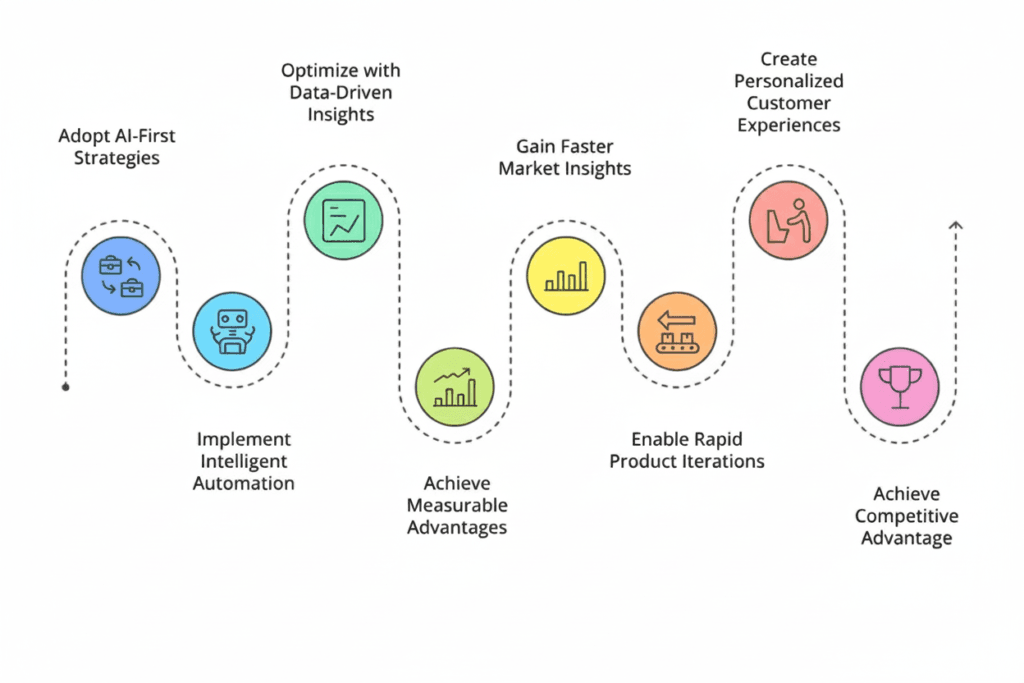
An AI-first app strategy delivers benefits that compound over time, rather than plateauing after launch. One of the most powerful advantages is the ability to deliver deep personalization without exploding complexity. Instead of maintaining separate features or flows for different user types, a single intelligent system adapts behavior dynamically based on context, history, and intent. This allows products to scale in relevance without scaling in surface area.
Automation is another major benefit. AI-first systems remove entire categories of repetitive decisions—sorting, filtering, prioritizing, routing—that would otherwise require manual input or constant feature additions. As the system learns, iteration cycles accelerate. Teams spend less time redesigning interfaces and more time refining intelligence through data and feedback. Improvements happen continuously, often without visible changes to the UI.
Perhaps most importantly, AI-first products become defensible. While interfaces and features can be copied, intelligence trained on real usage data is difficult to replicate. As adoption grows, the system becomes smarter, more accurate, and more valuable—creating a positive feedback loop. Instead of becoming brittle with scale, the product strengthens as it is used.
🔑 Key Points
- Personalization scales without added complexity
- Repetitive decisions are automated away
- Learning replaces constant redesign
- Engagement improves through relevance
- Intelligence creates defensible differentiation
- Product value increases with usage
⚠️ Challenges Teams Must Prepare For
While AI-first development unlocks powerful advantages, it also introduces new responsibilities and risks that teams must actively manage. Data quality becomes a critical dependency; biased, incomplete, or outdated data directly affects system behavior. Unlike traditional bugs, these issues can be subtle, systemic, and hard to detect without proper monitoring and governance.
Teams must also design for uncertainty. AI systems are probabilistic by nature, meaning they operate with varying levels of confidence. Applications must gracefully handle low-confidence scenarios, unexpected inputs, and model failures. Privacy and ethical considerations take on greater importance, as intelligent systems often rely on sensitive user data. Ensuring transparency, consent, and responsible use is not optional—it is foundational.
Another challenge lies in balancing automation with human judgment. Over-automation can erode trust if users feel locked out of decisions that matter to them. Successful AI-first teams deliberately design escalation paths, override mechanisms, and explainability into the product. Ultimately, success depends not just on technical excellence, but on governance, transparency, and trust embedded throughout the system.
🔑 Key Points
- Data quality directly impacts intelligence quality
- Systems must handle uncertainty gracefully
- Privacy and ethics are core design concerns
- Automation must respect human judgment
- Governance and trust are critical success factors
🔮 Where AI-First App Development Is Headed
The future of AI-first app development is not about replacing users—it is about deep collaboration between humans and intelligent systems. Applications are evolving beyond standalone tools into intelligent entities that support users continuously. Rather than executing isolated tasks, future systems will reason across workflows, anticipate needs, and coordinate actions on behalf of users.
We are moving toward a world with fewer rigid “apps” and more adaptive systems that blend interfaces, automation, and reasoning seamlessly. These systems will act as copilots that guide users, decision partners that evaluate trade-offs, and workflow orchestrators that connect people, tools, and data across platforms. Intelligence will persist across devices and contexts, creating continuity rather than fragmentation.
As this evolution continues, the boundary between software and assistant will blur. The most successful products will not be those with the most features, but those that understand goals, adapt intelligently, and grow alongside their users.
🔑 Key Points
- AI-first apps emphasize collaboration, not replacement
- Systems act as copilots and decision partners
- Workflows are orchestrated end-to-end
- Interfaces, automation, and reasoning converge
- Fewer apps, more adaptive intelligent systems
❓ Frequently Asked Questions (FAQ)
AI-first development treats intelligence as a foundational system layer rather than an optional feature. Instead of bolting AI onto an existing app, the entire product—architecture, workflows, and user experience—is designed around learning, prediction, and decision-making from the start.
Not always. While greenfield projects benefit most from AI-first thinking, existing apps can evolve toward AI-first by gradually embedding intelligence into core workflows, introducing data pipelines, and replacing rigid logic with adaptive models over time.
AI-first development requires cross-functional collaboration. In addition to traditional frontend and backend engineers, teams need data scientists, ML engineers, product managers comfortable with probabilistic systems, and designers who understand adaptive and explainable user experiences.
Trust is built through transparency, governance, and control. AI-first apps include explainable outputs, confidence indicators, human-in-the-loop workflows, and strong monitoring for bias, drift, and performance degradation to ensure reliable behavior over time.
AI-first approaches are most valuable for products involving decisions, personalization, automation, or complex workflows. While not every app needs deep intelligence, products that benefit from adaptation, relevance, and scale gain significant advantages from AI-first design.