🆚 TypeScript vs Python
“Two giants. Different strengths. One big decision for developers.”
Choosing between TypeScript and Python can feel like choosing between speed and safety, simplicity and structure, or flexibility and scale.
Both languages dominate in 2025 — but they shine in different areas.
This blog breaks down the strengths, weaknesses, and use-cases for AI, web development, and automation to help students, developers, and businesses decide which language fits their goals best.
🚀 TypeScript vs Python: The Core Differences
When comparing TypeScript and Python, you’re not just comparing two programming languages — you’re comparing two completely different philosophies of building software. Each language has evolved to dominate different parts of the technology ecosystem, and in 2025, both have become essential skills for modern developers, students, and businesses. Understanding their core differences helps you choose the right tool for the right job — whether you’re building AI systems, web apps, automation scripts, or scalable enterprise software.
🐍 Python — The King of Simplicity, AI, and Rapid Prototyping
Python has earned a legendary reputation for being one of the simplest programming languages ever created. Its syntax feels like writing English, making it incredibly easy for beginners to pick up and for experts to build complex systems rapidly. But Python’s true power lies in its ecosystem. Libraries like NumPy, Pandas, Matplotlib, SciPy, TensorFlow, PyTorch, Scikit-learn, and FastAPI dominate scientific computing, data analytics, automation, and artificial intelligence.
In 2025, Python powers nearly 80% of global AI research, from small student ML projects to large-scale enterprise models. Top companies like Google, OpenAI, Meta, and Microsoft rely heavily on Python as the backbone for training neural networks, processing massive datasets, building AI assistants, computer-vision systems, and high-performance research pipelines.
Python also excels in automation and system scripting. DevOps engineers prefer it for writing system-level tasks, handling APIs, web scraping, networking utilities, bots, and backend microservices. Its flexibility allows developers to move from prototype to production without switching languages.
For students, Python remains the number one entry point into programming because it removes the complexity barrier and allows them to focus on logic, problem solving, and building projects that matter — from AI models to automation tools. For businesses, Python offers rapid development, simplicity, and access to the world’s largest machine learning ecosystem.
However, Python is not without limitations. It is slower at runtime, lacks native type safety (unless you add optional typing tools like mypy), and is not ideal for building modern, interactive frontends. Still, for AI and automation, Python remains unmatched.
🟦 TypeScript — JavaScript’s Smarter, Safer, Scalable Evolution
While Python rules AI, TypeScript dominates the modern web. Built by Microsoft as a superset of JavaScript, TypeScript adds static typing, interfaces, generics, and strong tooling features that bring structure and reliability to JavaScript applications.
In 2025, TypeScript is now the default language for professional web development, powering everything from personal websites to large-scale enterprise dashboards, SaaS platforms, and cloud-native applications. Frameworks like Next.js 15, Remix, SvelteKit 2.0, Angular 18, Astro, Node.js, Bun, and Deno all offer first-class TypeScript support — making it almost impossible to work in modern frontend or backend JavaScript development without using TS concepts.
TypeScript shines in situations requiring scalability, modularity, and enterprise engineering discipline. Its type system helps developers catch bugs early, enforce rules, reduce runtime failures, improve code readability, and collaborate effortlessly in large teams. As applications grow beyond a few thousand lines of code, JavaScript often becomes chaotic — but TypeScript keeps things predictable and maintainable.
What makes TypeScript especially powerful is that it bridges both frontend and backend development. The same TypeScript codebase can power your UI components, your API endpoints, your serverless functions, and even your AI-driven user dashboards. This creates a seamless full-stack experience that Python cannot replicate.
In the world of cloud development, TypeScript has become the preferred language for integrating with AWS Lambda, Vercel, Cloudflare Workers, Firebase, and serverless systems — where speed and type-safety matter deeply.
However, TypeScript requires understanding JavaScript fundamentals, asynchronous programming, and build tools — making it slightly harder for beginners compared to Python. Yet, once mastered, TypeScript becomes a long-term career investment that future-proofs your skills in the ever-evolving web ecosystem.
⚡ JavaScript & TypeScript in 2025: The Future of Web Development
This is not just an upgrade — it’s a transformation of how we code, deploy, and think about the web.
👉 Learn More🌐Web Development: Which One Should You Choose?
When it comes to web development, the comparison between TypeScript and Python is not even close — TypeScript is the clear and unquestioned leader in 2025. Modern web applications demand real-time updates, reactive UIs, dynamic rendering, micro-frontends, edge-computing compatibility, and seamless integration between frontend and backend logic. These requirements perfectly align with TypeScript’s strengths, making it the default language for serious web development.
TypeScript’s dominance comes from its deep integration with the JavaScript ecosystem. Because the web itself runs on JavaScript, TypeScript essentially becomes the “supercharged” version of the web’s native language — giving developers the benefit of static typing, cleaner architecture, better error checking, and more predictable code behavior. In large codebases, TypeScript reduces bugs dramatically by catching issues during development instead of at runtime.
This is why leading frameworks like Next.js 15, SvelteKit, Angular, Remix, Astro, Solid.js, Node.js, Bun, and even the new Deno runtime all support TypeScript natively. React, the most widely used UI framework on the planet, now recommends TypeScript as the default setup for new projects. Developers building dashboards, SaaS platforms, admin panels, e-commerce systems, AI-powered interfaces, or cross-platform apps rely heavily on TypeScript to ensure long-term maintainability and team scalability.
TypeScript also excels at real-time and interactive web applications, thanks to its tight integration with WebSockets, event-driven tools, serverless runtimes, and edge computing environments. For example, a TypeScript-based Next.js application can stream UI updates, process live user interactions, and run server-side logic at the edge — none of which Python can do efficiently in the frontend ecosystem.
Another advantage is tooling. VS Code (built by Microsoft) was designed with TypeScript in mind, giving developers incredible features like IntelliSense, auto-completion, refactoring tools, type suggestions, and inline error detection. This dramatically improves development speed and reduces the learning curve in large-scale applications. Companies love TypeScript because it makes onboarding easier, reduces production errors, and creates clean, enterprise-grade architecture that is predictable and scalable.
In contrast, Python has very limited support for interactive web development. Frameworks like Django, Flask, and FastAPI are still fantastic choices for backend REST APIs, authentication services, data pipelines, or microservices — but they simply cannot compete when it comes to UI rendering, client-side interactions, or real-time web interfaces. Python cannot run in the browser, and even when paired with a frontend framework, it relies entirely on JavaScript/TypeScript for rendering logic.
Python-based web apps often need a split architecture:
- Python for backend logic
- JavaScript/TypeScript for frontend UI
This adds additional complexity — making TypeScript-based full-stack tools like Next.js, SvelteKit, and Remix far more attractive for developers who want a unified language experience across frontend, backend, APIs, and serverless functions.
Furthermore, the rise of micro-frontends, edge-rendered applications, AI-driven UI components, and server actions in frameworks like Next.js has pushed TypeScript even further ahead, since these architectures depend on a tightly typed, predictable language capable of handling rapid UI changes and shared component logic across teams.
In today’s ecosystem, TypeScript is not just an advantage — it is the industry standard for scalable, maintainable, and modern web development. Python still plays an important role, but that role is almost entirely on the backend.
🔥 Winner: TypeScript for Web Development
Python powers the logic.
TypeScript powers the experience.
In 2025 and beyond, TypeScript builds the modern web — end to end.
📊 Syntax Comparison: TypeScript vs Python
| Feature / Concept | TypeScript Syntax | Python Syntax | What It Means for Developers |
|---|---|---|---|
| Variable Declaration | let age: number = 25 | age = 25 | Python is simpler, TS is safer due to explicit types. |
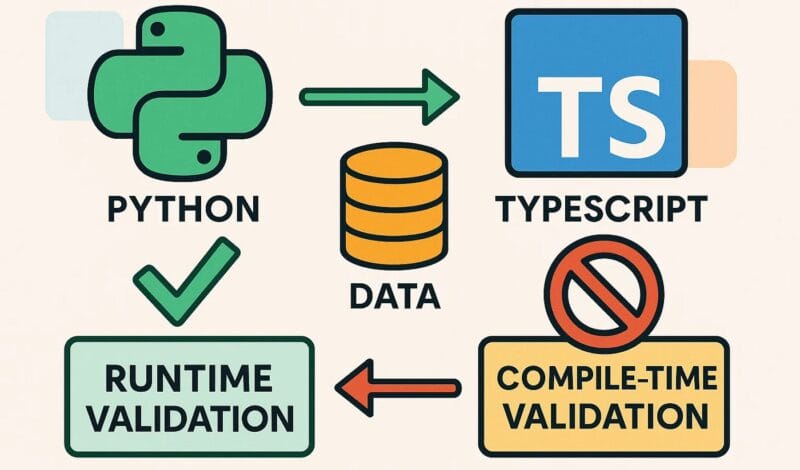
| Functions | function add(a: number, b: number): number { return a + b } | def add(a, b): return a + b | TS provides type hints at compile-time; Python checks at runtime. |
| Classes | class Person { constructor(public name: string) {} } | class Person: def __init__(self, name): self.name = name | TS is more aligned with traditional OOP; Python is more flexible. |
| Type System | Static typing (strict) | Dynamic typing | TS reduces runtime errors, Python speeds up prototyping. |
| Interfaces / Types | interface User { name: string; age: number } | No native interfaces | TS supports strong abstraction; Python needs external typing tools. |
| Asynchronous Code | async function run() { await fetchData() } | async def run(): await fetch_data() | Similar syntax, but Python requires asyncio for async operations. |
| Modules / Imports | import { User } from "./user" | from user import User | Both are easy; TS supports ES modules + build-time checks. |
| Error Handling | try { ... } catch (e) { ... } | try: ... except Exception as e: | Nearly identical; TS benefits from typed errors. |
| Comments | // Single-line / /* Multi-line */ | # Single-line / ''' Multi-line ''' | Both are simple, but Python’s triple-quote comments double as docstrings. |
| Indentation / Blocks | { } braces define blocks | Indentation defines blocks | TS is more traditional; Python enforces readable code structure. |
📝 Summary
- Python is simpler and faster to write for beginners.
- TypeScript provides structure, safety, and fewer bugs in large projects.
- Python works best for AI, automation, data.
- TypeScript is ideal for web apps, servers, and enterprise-scale systems.
⚙️Automation & Scripting: Which Language Is More Practical?
When it comes to automation and scripting, Python has been the undisputed champion for more than a decade — and even in 2025, it continues to dominate. Python’s philosophy is built on simplicity: write less, get more done. Its clear syntax, extensive standard library, and massive ecosystem of automation-focused frameworks make it ideal for tasks like file handling, web scraping, task scheduling, data manipulation, and even interacting with complex APIs. Tools such as Requests for HTTP automation, BeautifulSoup and Scrapy for scraping, Selenium for browser automation, Fabric for remote execution, and Pandas for processing large datasets give Python a level of convenience that few languages can match. This makes Python the go-to choice for DevOps engineers, ethical hackers, data analysts, and students who want to automate repetitive daily tasks quickly and efficiently.
Python’s biggest strength is its ability to “just work” across operating systems with minimal setup. Need to rename 2,000 files? Write a 5-line Python script. Need to automate Excel? Use Python libraries like OpenPyXL. Need to monitor a folder and trigger actions? A few lines of Python are enough. This ease of use has made Python the first language people think of when automating anything inside their computer, especially for beginners and non-programmers.
But the narrative is shifting — and TypeScript (with Node.js) is emerging as a serious contender in automation, especially for web-first and cloud-native tasks. Automation today doesn’t just live inside a laptop; it runs on servers, edge functions, cloud workflows, CI/CD pipelines, and AI-powered systems. And this is where TypeScript shines. With Node.js, TypeScript can perform large-scale asynchronous operations with impressive speed. Developers can automate everything from API calls to cloud deployments using tools like AWS SDK, Firebase SDK, Supabase, Vercel Functions, Bun runtime, and serverless frameworks. In fact, much of the modern web’s automation — from sending emails to processing payments to updating dashboards — is built in TypeScript.
TypeScript’s strong typing system makes automations more reliable, especially in enterprise environments. A mistyped field in a Python script might fail silently or break at runtime, but TypeScript catches it during development. This helps teams working on complex workflows avoid costly debugging sessions. Moreover, with AI-assisted development (like Copilot or GPT-5.1 coding agents), TypeScript becomes even more powerful, enabling automated API orchestrations, dynamic scaling scripts, and error-proof integrations across cloud platforms.
However, when the automation involves deep interaction with the operating system — such as file systems, shell commands, cron-like tasks, local batch processes, system-level triggers — Python is still the simpler and faster choice. TypeScript can do these tasks using Node packages, but Python’s ecosystem was purpose-built for system scripting, giving it a natural advantage.
In short:
- Python remains unbeatable for OS-level scripting, DevOps tasks, scraping, quick utilities, and anything requiring fast prototyping with minimal setup.
- TypeScript is rapidly rising as the automation powerhouse for APIs, cloud systems, microservices, webhooks, serverless functions, distributed workflows, and AI-powered apps.
As we move deeper into a cloud-driven world, many businesses and developers now combine both languages — using Python for local/system automation and TypeScript for cloud/web automation. Together, they form the ultimate automation toolkit for 2025 and beyond.
🧪Prompts to Try (Supercharged for Learning & Real Projects)
One of the most powerful ways to understand the difference between TypeScript and Python is by trying real-world prompts that reflect how developers use these languages in 2025. These prompts aren’t just random examples — they are practical exercises that students, developers, and businesses can use to build actual workflows, dashboards, APIs, and automation systems. Each prompt below helps highlight the strengths of its respective language, while demonstrating how AI tools like GPT-5.1 can assist you in writing production-ready code.
🐍 Python Prompt — Data Analysis & Automation Expert
Prompt:
“Write a Python script using Pandas to identify anomalies in a CSV dataset using Z-score analysis. Explain each step in detail.”
Python excels in data processing and analytical tasks because of its extensive ecosystem built around scientific computing. With this prompt, students can learn how to load datasets, calculate Z-scores, detect anomalies (like fraud, outliers, or unusual trends), and visualize the results. Businesses often use similar scripts for financial monitoring, user behavior tracking, or quality control. The request for step-by-step explanation makes it perfect for beginners who want to understand the logic behind every operation. This prompt teaches foundational data literacy — a crucial skill in AI and automation careers.
🟦 TypeScript Prompt — Web API & Validation Champion
Prompt:
“Generate a TypeScript-based Next.js API route that connects to MongoDB, validates input using Zod, and responds with structured JSON results.”
This prompt shows why TypeScript dominates modern web development. It touches multiple real-world components:
- building a serverless API route in Next.js
- connecting securely to MongoDB
- validating request payloads using Zod (a popular 2025 standard)
- returning clean, typed JSON responses
This is exactly how production apps are built today — from user registration systems to dashboards, micro-frontends, SaaS platforms, and internal tools. Students can use this prompt to create portfolio-ready full-stack features, while businesses can use it to rapidly prototype reliable backend endpoints. TypeScript ensures type safety, eliminates runtime errors, and helps developers write scalable, maintainable code.
🤖 AI Prompt — Intelligent Language Selection
Prompt:
“Compare TypeScript and Python for a student building an AI-powered task automation tool. Recommend which language fits each part of the project.”
This AI prompt encourages strategic thinking — a skill every modern developer needs. Instead of asking AI to generate code, you’re asking it to reason about architecture. Students can learn how to structure a multi-language project:
- Python for data processing, AI model inference, workflow logic
- TypeScript for UI, dashboards, API endpoints, serverless triggers
- Cross-language communication using Webhooks or REST APIs
- When to choose performance vs safety vs ease of use
These types of prompts help users understand why one language fits a particular part of the system better, instead of blindly following trends. For businesses, such insights guide decision-making when building scalable, AI-driven products or automation tools
🧩Real Use Case: How Mystic Matrix Uses Both TypeScript & Python Together
At Mystic Matrix Technologies, we don’t choose between TypeScript and Python — we use them strategically based on their strengths. In modern AI-driven software development, no single language can solve every challenge. Instead, the true power comes from combining the scalability of TypeScript with the intelligence and analytical capabilities of Python. This hybrid approach allows us to build high-performance, full-stack AI systems that are reliable, fast, and incredibly flexible for students, businesses, and enterprise clients.
On the frontend and system architecture side, TypeScript is our backbone. We use TypeScript to build interactive AI-powered dashboards, role-based workflow systems, and micro-frontend widgets that function like independent apps inside a larger interface. Its type-safety ensures fewer bugs, predictable scaling, and cleaner code structure — crucial for enterprise systems where multiple teams work on the same codebase. For example, our AI-driven task management dashboard, used by different roles (User → Manager → Admin → Super Admin), is built entirely in TypeScript using modern frameworks like Next.js and SvelteKit. TypeScript also powers real-time analytics UIs, serverless cloud functions, and intelligent chatbot frontends that integrate seamlessly into client websites.
On the backend and AI side, Python takes the lead. Python handles everything related to machine learning: from AI model training and vector search pipelines to NLP preprocessing and data retrieval workflows. Our internal automation systems rely heavily on Python scripts for ETL operations, embedding generation, and managing AI micro-services. Python powers the heavy computation behind the scenes — making predictions, analyzing datasets, and generating tailored AI insights for users. Its vast ecosystem of ML libraries allows us to experiment rapidly and deploy AI features without re-inventing the wheel.
Together, these two languages form a powerful ecosystem. TypeScript delivers fast, responsive, and stable user interfaces, while Python provides the intelligence, computation, and automation logic underneath. This dual-language architecture is how we’re able to build AI chatbots that understand context in real time, grid dashboards that crunch large volumes of system data, and micro-frontends that update independently without breaking the entire application. Students benefit from this approach because it shows the real industry workflow — Python for AI, TypeScript for web apps. Businesses benefit because they receive high-performance products engineered with the best tool for each job.
🤝 The result?
Truly full-stack AI applications — where Python thinks, and TypeScript communicates those insights beautifully.
⚠️Drawbacks of Each Language (and How to Avoid Them)
Even though TypeScript and Python are incredibly powerful in 2025, both languages come with certain limitations. Understanding these weaknesses — and knowing how to mitigate them — is essential for building scalable, reliable, and future-ready applications. At Mystic Matrix, we teach developers to choose the right tool for the right job while designing hybrid systems that overcome these limitations.
🟦 TypeScript Drawbacks — and How to Stay Safe
TypeScript, despite being the gold standard for large-scale web development, can become overwhelming for beginners. Its type system is powerful but can grow extremely complex when working with advanced generics, utility types, or large enterprise architectures. This leads many new developers to feel “blocked” by type errors rather than empowered by type safety. In addition, TypeScript requires tooling — bundlers, compilers, configs — which adds friction compared to Python’s simple “run the file” approach. And because TypeScript runs on Node.js, it’s not well-suited for CPU-heavy or scientific workloads like mathematical simulations, massive data processing, or ML model training.
How to Protect Yourself:
Start small. Use TypeScript for scalability and maintainability, not for every experimental script or tiny prototype. Keep type definitions simple at first — avoid deep generics until you gain confidence. Offload heavy computational tasks to serverless cloud functions or Python micro-services rather than forcing Node.js to do heavy lifting. For students and businesses building full-stack applications, pair TypeScript with Python to balance performance and simplicity. This hybrid model ensures that TypeScript handles UI, APIs, and real-time dashboards, while Python handles computation and AI workloads.
🐍 Python Drawbacks — and How to Stay Safe
Python remains the backbone of AI and automation, but it has limitations that can affect large-scale or fast-paced applications. Python is significantly slower at runtime compared to TypeScript/Node.js or compiled languages like Go, Rust, and C++. This makes Python a poor choice for real-time applications, high-frequency trading systems, or large concurrent web servers. Its dynamic typing — while flexible — is also one of its biggest risks. Developers often run into runtime errors that TypeScript would have prevented at compile time. Python also lacks native support for modern UI development, mobile apps, or rich interactive frontends, which limits its use outside backend and AI tasks.
How to Protect Yourself:
Introduce static typing using tools like mypy or Pyright to reduce runtime errors and improve debugging. Use virtual environments to prevent dependency conflicts — a major source of Python frustration. Avoid using Python for frontend, real-time dashboards, or low-latency systems; instead pair it with TypeScript or frameworks like Next.js for UI and user-facing interactions. For businesses handling mission-critical workloads, implement caching layers, worker queues, and micro-services to offset Python’s performance limitations. And for students, learning when not to use Python is just as important as learning how to write Python.
🤝 The Smart Strategy: Use Both Together
Neither TypeScript nor Python is perfect on its own — but together, they fill each other’s gaps.
Python handles intelligence; TypeScript handles interaction.
Python computes; TypeScript delivers.
Python manages workflows; TypeScript powers the user experience.
By combining them, developers and businesses can build future-proof, scalable, AI-powered systems without inheriting the weaknesses of either language.
❓ Frequently Asked Questions (FAQ)
Neither is universally “better.” TypeScript is ideal for scalable web apps, while Python excels in AI, automation, and data science. The best choice depends on your project goals.
Python is easier for absolute beginners due to its simple syntax. TypeScript is better if you want to build modern web apps or full-stack projects from day one.
Not yet. Python still leads due to its vast ML ecosystem (TensorFlow, PyTorch). TypeScript works well for deploying AI models, not training them.
Yes. Many companies use Python for AI backend services and TypeScript for frontend/UI, dashboards, APIs, and serverless functions — a powerful hybrid approach.
Both are highly in demand. Python dominates AI, data science, and automation, while TypeScript dominates modern web development and enterprise full-stack roles.