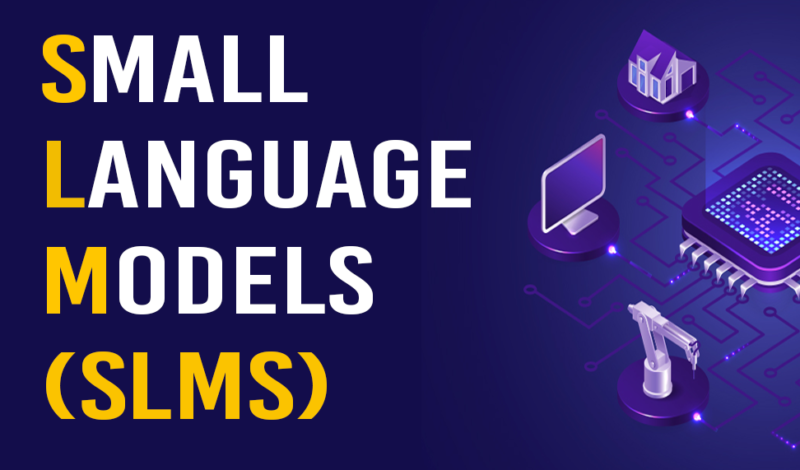
🧠 Small Language Models (SLMs)
For much of the past decade, artificial intelligence followed a simple assumption: intelligence improves as models grow larger. The industry invested billions of dollars in building massive language models with increasingly enormous parameter counts, believing scale alone would unlock universal reasoning, creativity, and comprehension. These giant systems were positioned as general-purpose digital brains—capable of answering any question, writing any content, and solving any problem. While they succeeded in demonstrating remarkable capability, they also introduced new challenges in cost, latency, governance, and reliability.
In real operational environments, businesses quickly discovered that bigger does not always mean better. High-volume enterprise workflows require speed, consistency, predictability, and controllability far more than open-ended creativity. Running trillion-parameter models for routine classification, document parsing, compliance checks, or customer routing is not only inefficient—it is often impractical. The result has been a strategic shift toward a new category of AI: Small Language Models (SLMs).
SLMs are compact, domain-specialized models engineered to perform specific business functions with extreme efficiency and precision. Rather than attempting to model all human knowledge, they are optimized around clearly defined objectives, datasets, and workflows. This focus allows them to deliver faster inference, lower infrastructure costs, stronger governance, and far more reliable outputs. In environments where latency, privacy, compliance, and scale are mission-critical, SLMs consistently outperform larger general-purpose models.
This evolution is not a technological retreat—it is an architectural maturation. Organizations are moving away from monolithic “giant brain” models toward modular intelligence systems composed of specialized workers coordinated by reasoning engines. Small models are becoming the operational core of AI platforms, executing the majority of real-world decisions, classifications, and automations. They are easier to audit, safer to deploy, cheaper to operate, and more predictable in behavior—making them ideal for enterprise adoption.
The rise of SLMs signals a new era of practical intelligence—where effectiveness, trust, and efficiency define success, not raw parameter counts. As AI becomes embedded into everyday operations, the future belongs not to the biggest models, but to the smartest architectures—and smaller models are proving to be the strongest foundation.
🧩 What Are Small Language Models (SLMs)?
Small Language Models (SLMs) represent a fundamental shift in how artificial intelligence is designed, deployed, and trusted inside real-world systems. Rather than attempting to replicate broad, human-like general intelligence, SLMs are purpose-built for precision, speed, and reliability within clearly defined domains. These models typically operate in the range of millions to a few billion parameters—making them dramatically lighter, faster, and easier to control than massive general-purpose models.
What truly defines SLMs is not just their size, but their specialization. They are trained on tightly scoped datasets aligned with specific business functions, regulatory environments, and operational workflows. This means an SLM developed for financial compliance understands accounting language deeply but does not waste capacity on unrelated creative knowledge. An SLM used for medical summarization learns clinical structure and terminology precisely, reducing hallucination risk and improving consistency. Their intelligence is targeted, not diluted.
SLMs are engineered to excel in high-volume, repetitive, and mission-critical tasks where correctness, latency, and governance matter more than creativity. In enterprise systems, they become the silent operational workforce—classifying, validating, extracting, scoring, routing, and enforcing rules continuously across digital workflows. They deliver deterministic behavior, predictable outputs, and far stronger auditability compared to giant general models.
This architectural focus enables SLMs to be deployed privately, at the edge, inside regulated infrastructure, and even within air-gapped environments—making them ideal for finance, healthcare, government, and security use cases. As organizations move from experimenting with AI to embedding it into daily operations, SLMs are emerging as the true execution layer of modern AI stacks.
SLMs are not simplified versions of large models—they are optimized systems designed to do fewer things exceptionally well, creating a new foundation for scalable, compliant, and trustworthy artificial intelligence.
🔑 Key Takeaways
- SLMs are compact, domain-specialized AI models
- Built for precision, speed, and governance—not general creativity
- Optimized for high-volume operational workloads
- Deliver predictable, auditable, low-latency outputs
- Ideal for regulated, private, and edge deployments
- Form the execution backbone of modern enterprise AI stacks
📱 Embedding LLMs Inside Mobile Apps
Mobile apps are no longer just interfaces for consuming content or completing tasks. In 2026, the most successful apps are becoming intelligent companions — capable of understanding users, reasoning over context, and responding in natural language.
👉 Read More⚡ Why Smaller Models Are Winning
1️⃣ Speed Beats Scale
In modern digital systems, speed is no longer a convenience—it is a competitive requirement. Users expect instantaneous responses, real-time dashboards, and automated workflows that operate at machine speed. Large general-purpose models, while powerful, introduce significant latency due to their size, infrastructure complexity, and heavy inference pipelines. In contrast, Small Language Models are engineered for near-instant execution, making them ideal for real-time business environments.
SLMs load faster, process requests quicker, and scale horizontally without requiring expensive GPU clusters. This makes them perfect for always-on systems such as customer support bots, transaction screening engines, fraud detection pipelines, compliance validators, and operational dashboards. In these contexts, the business value lies in responsiveness, not philosophical reasoning depth. A faster model that responds instantly and consistently delivers more operational value than a massive model that pauses to “think.”
Speed directly translates to better user experience, higher automation throughput, and reduced system bottlenecks. As enterprises move toward real-time decision architectures, the speed advantage of SLMs becomes decisive.
Key points:
- Latency matters more than raw reasoning depth
- SLMs deliver instant responses at scale
- Faster execution improves automation throughput
- Enables real-time enterprise workflows
- Reduces infrastructure bottlenecks
2️⃣ Cost Efficiency at Scale
Running giant models at enterprise scale is financially unsustainable for most organizations. Every API call, GPU minute, and inference cycle compounds operational expenses. SLMs dramatically reduce this burden by running efficiently on standard CPUs, edge devices, and low-cost cloud infrastructure. This allows organizations to deploy AI continuously rather than selectively.
With SLMs, AI can be embedded into every workflow—classification, routing, validation, extraction, scoring—without worrying about runaway compute bills. The result is always-on intelligence that scales predictably. Companies can expand automation horizontally across departments instead of rationing AI usage to only high-value scenarios.
The economics of SLMs make AI financially practical, not just technologically impressive.
Key points:
- Reduces inference costs by 10×–100×
- Runs on low-cost infrastructure
- Enables always-on automation
- Predictable scaling economics
- Makes enterprise AI financially sustainable
3️⃣ Easier to Control and Govern
As AI becomes embedded into regulated business operations, governance is no longer optional—it is mandatory. Smaller models are significantly easier to audit, constrain, monitor, and certify. Their narrower training scope reduces hallucinations, improves output consistency, and simplifies policy enforcement.
SLMs allow organizations to implement deterministic guardrails, explainable outputs, and consistent behavior patterns. This is critical in industries such as finance, healthcare, legal, and government where every decision must be explainable, traceable, and compliant with regulatory standards.
Large general models are powerful—but they are difficult to tame. SLMs are designed to be controlled.
Key points:
- Lower hallucination risk
- Easier policy enforcement
- Predictable behavior patterns
- Simplified compliance and audits
- Ideal for regulated industries
4️⃣ Better Accuracy for Narrow Tasks
SLMs outperform giant models where it matters most—domain-specific work. Because they are trained on focused datasets aligned with specific workflows, they achieve higher precision, consistency, and reliability in narrow tasks.
They understand financial terminology, medical classification, legal structures, compliance workflows, and operational patterns far more deeply than general models. This specialization reduces irrelevant reasoning, eliminates noise, and produces cleaner outputs.
In enterprise automation, reliability beats creativity.
Key points:
- Higher accuracy in domain-specific workflows
- More consistent outputs
- Reduced hallucination
- Better structured reasoning
- Ideal for repetitive, high-volume tasks
5️⃣ Ideal for Edge & Private Deployment
SLMs unlock true privacy-first AI. They can operate on-device, within private cloud networks, and even in air-gapped environments. This ensures sensitive data never leaves the organization’s security perimeter.
This capability is essential for healthcare, defense, finance, and critical infrastructure where cloud exposure is unacceptable. SLMs allow organizations to bring intelligence to the data—rather than sending data to external AI providers.
Key points:
- Supports on-device and private deployment
- Works in air-gapped environments
- Maintains data sovereignty
- Eliminates third-party data exposure
- Enables secure enterprise AI
🧠 The New AI Stack: Big Brains + Small Specialists
The future of artificial intelligence is not a battle between large and small models — it is the rise of Hybrid AI Architecture.
Modern AI systems are evolving into intelligent ecosystems composed of specialized layers, each designed to perform a specific cognitive function at maximum efficiency. Instead of relying on one massive model to do everything, organizations now deploy large reasoning engines supported by fast, specialized operational models, governed by deterministic rule layers.
This layered design creates AI platforms that are faster, safer, cheaper, more explainable, and dramatically more scalable.
| AI Layer | Purpose | What It Actually Does | Why It Matters |
|---|---|---|---|
| LLM – Strategic Reasoning Layer | High-level intelligence, reasoning, creativity, orchestration | Acts as the “thinking brain” of the system. Handles complex conversations, long-form reasoning, decision synthesis, multi-step planning, and natural language generation. Coordinates tasks across AI agents and tools. | Provides intelligence, adaptability, and human-like reasoning for complex workflows. |
| SLM – Operational Execution Layer | Fast automation, classification, validation, extraction, enforcement | Acts as the “workforce” of the AI platform. Performs high-volume tasks such as routing, scoring, document extraction, fraud detection, compliance checks, and data labeling with extreme speed and precision. | Enables always-on, scalable, low-cost automation across business systems. |
| Rules & Policy Layer – Governance & Control | Compliance enforcement, safety, deterministic logic | Acts as the “law system” of the platform. Applies regulatory constraints, approval workflows, escalation rules, and guardrails that ensure predictable, explainable, and legally compliant behavior. | Ensures trust, auditability, security, and regulatory compliance. |
🏢 Where Small Language Models (SLMs) Are Dominating
Small Language Models are not experimental technologies—they are already becoming the operational backbone of modern enterprises. Their speed, determinism, and governance-friendly design make them ideal for industries where decisions must be fast, accurate, explainable, and cost-efficient. Below are the sectors where SLMs are redefining how intelligence is deployed at scale.
💰 Finance
In financial systems, milliseconds matter and compliance is mandatory. SLMs have become the preferred intelligence layer for fraud detection, transaction classification, document parsing, revenue recognition checks, and real-time forecasting signals. Because they are trained on highly structured financial language and workflows, they outperform general-purpose models in recognizing abnormal patterns, flagging suspicious behavior, and extracting structured information from invoices, bank statements, and tax documents.
SLMs operate continuously across payment pipelines, accounting systems, and compliance engines without introducing latency or excessive compute cost. They are deterministic, auditable, and easily constrained by regulatory policy layers—making them ideal for environments governed by SOC, PCI, SOX, and AML requirements.
🏥 Healthcare
Healthcare workflows require extreme accuracy, data privacy, and explainability. SLMs dominate clinical summarization, triage classification, diagnostic routing, medical coding, and patient documentation pipelines. Unlike large open models, SLMs can be trained exclusively on medical language and institutional guidelines—greatly reducing hallucinations and increasing consistency.
They can be deployed on private hospital infrastructure or even on-device, ensuring that sensitive patient data never leaves secure environments. This makes them essential for HIPAA-compliant AI systems, digital health platforms, and hospital automation pipelines.
💻 SaaS & Enterprise Software
In SaaS platforms, SLMs serve as the hidden workforce behind support routing, ticket classification, churn prediction, onboarding automation, and knowledge base tagging. Their speed enables real-time customer workflows, while their low compute cost allows AI to be embedded across every product surface—not just premium features.
SLMs allow SaaS companies to offer intelligent automation at scale without exploding infrastructure costs. They improve retention, reduce support workload, and create predictive intelligence layers inside modern digital products.
⚖️ Legal & Compliance
Legal environments demand precision and traceability. SLMs excel in contract analysis, compliance scoring, clause extraction, regulatory screening, and risk classification. Their focused training makes them significantly more accurate at understanding legal structure and terminology than general-purpose models.
They also allow firms to deploy AI inside private legal data centers and air-gapped systems—maintaining full data sovereignty while accelerating document-heavy workflows.
🏭 Manufacturing & Industrial Systems
In industrial environments, SLMs analyze sensor data, detect anomalies, classify machine states, and flag early signs of equipment failure. Their low latency and edge deployment capability allow them to run directly on factory-floor devices, providing real-time intelligence without cloud dependency.
This enables predictive maintenance, production optimization, and operational safety at massive scale.
🛡️ Cybersecurity
Cybersecurity operations demand constant vigilance. SLMs dominate in behavior classification, intrusion detection, alert scoring, threat prioritization, and log analysis. Their deterministic behavior makes them ideal for security automation pipelines where false positives must be minimized and auditability is mandatory.
They provide always-on intelligence that can analyze millions of events per second while maintaining explainability for SOC teams.
🔮 The Future Belongs to Small Intelligence
We are entering a new phase of artificial intelligence—one defined not by size, but by specialization, coordination, and trust. The era of monolithic “giant brain” models is giving way to a more mature architectural paradigm: ecosystems of small, purpose-built intelligence units working together as an intelligent digital workforce. Rather than relying on a single massive model to do everything, modern AI platforms are being designed as distributed systems composed of specialized agents that execute precise tasks with speed, accuracy, and accountability.
In this emerging model, Small Language Models become the operational core of AI infrastructure. Each model is trained for a specific role—classification, extraction, risk scoring, compliance validation, routing, anomaly detection—operating continuously across enterprise workflows. These models are coordinated by higher-level reasoning engines that handle planning, orchestration, and complex synthesis. Governance layers sit above and around them, enforcing policy, compliance, privacy, and safety. The result is an AI system that behaves less like a single “super-intelligence” and more like a highly efficient organization of digital employees.
This architecture fundamentally changes how AI scales. Intelligence can be deployed everywhere, not just in select premium features. Models can be placed close to data—on-device, on-premise, inside secure private clouds—preserving privacy and data sovereignty. Updates and improvements can be applied to individual components without destabilizing entire systems. This makes AI safer, more maintainable, more economical, and dramatically more adaptable to business realities.
SLMs are not weaker forms of large models—they are optimized forms of intelligence, engineered for real-world performance. They are faster because they are focused. They are safer because they are constrained. They are cheaper because they are efficient. And they are more deployable because they can operate anywhere, at any scale, without fragile infrastructure. In production environments—where reliability, governance, and cost efficiency matter more than abstract capability—this makes small intelligence the true competitive advantage.
❓ Frequently Asked Questions (FAQ)
Not in real business environments. SLMs are designed to excel at specific tasks such as classification, extraction, routing, and compliance workflows. Because they are trained on focused datasets and operate within defined boundaries, they are often more accurate, faster, and more reliable than large general-purpose models for operational use cases.
SLMs are ideal when speed, cost efficiency, privacy, and governance matter—such as in finance, healthcare, legal, SaaS operations, manufacturing, and cybersecurity. LLMs are better suited for open-ended reasoning, creativity, and orchestration, while SLMs should handle high-volume execution.
Yes. One of the biggest advantages of SLMs is their ability to run inside private clouds, air-gapped systems, and on-device environments. This enables privacy-first AI deployments where sensitive data never leaves organizational boundaries.
Yes. Because SLMs operate within narrowly defined domains and controlled datasets, they produce more deterministic and predictable outputs, dramatically reducing hallucinations and unexpected behavior compared to large general-purpose models.
No—the future is hybrid. Large models will remain the reasoning and orchestration layer, while SLMs will become the execution workforce of AI platforms. Together, they form scalable, secure, and production-ready intelligence systems.