⚔️ Server-Side Rendering vs. Static Generation: Which One Wins in 2026?
The landscape of web development in 2026 looks radically different from what it was just a few years ago. The rise of powerful edge networks, AI-enhanced build pipelines, and hybrid rendering models has transformed the way developers think about how content is delivered to users. Frameworks like Next.js 15, SvelteKit, Nuxt 4, Astro, Remix, and Bun’s Ultra Runtime have evolved at such a rapid pace that choosing a rendering strategy is no longer a simple decision — it is a core architectural choice that can directly impact user experience, SEO performance, infrastructure cost, security posture, and the scalability of your entire product.
At the center of this evolution are two foundational approaches: Server-Side Rendering (SSR) and Static Site Generation (SSG). For more than a decade, these two models have shaped web performance strategies across industries — from eCommerce to SaaS, from media platforms to government portals. But in 2026, both techniques have undergone massive upgrades, unlocking new abilities and blurring the boundaries between static and dynamic rendering. SSR is no longer slow and expensive; SSG is no longer restricted to purely static pages. Both techniques have matured into flexible, high-performance systems supported by edge deployments, intelligent caching, AI-powered prefetching, streaming server components, and hybrid routing capabilities.
Why This Debate Matters More in 2026
Modern users expect instant load times, personalized experiences, and zero downtime, even on global traffic spikes. Businesses expect scalability without spiraling cloud bills. Developers want simpler mental models and predictable performance. Choosing between SSR and SSG — or more commonly, blending them — determines how seamlessly your app can adapt to these demands.
SSR shines when the content is personalized, rapidly changing, or requires real-time data pulled at the moment of request. In contrast, SSG excels when the goal is speed, predictability, global distribution, and massive scalability. But thanks to technologies like Incremental Static Generation, On-Demand Revalidation, React Server Components, and Edge Functions, both modes have expanded far beyond their original definitions. Developers now rely on intelligent build pipelines where pages can switch between static and dynamic rendering automatically based on data freshness, caching rules, or user state.
So Which One Wins in 2026?
The truth is, there is no single winner — because the winner depends on your project’s purpose. A high-traffic news page may benefit from SSG with fast revalidation. A finance dashboard, on the other hand, requires SSR to ensure users always see accurate, personalized data. AI-driven applications may combine both, delivering a static shell and dynamic user-specific insights on the fly. In 2026, the most successful products use a hybrid strategy, blending SSR and SSG at the page or even component level, allowing developers to optimize speed, personalization, and infrastructure efficiency simultaneously.
In this article, we break down how SSR and SSG evolved into their modern forms, explore their strengths and limitations, compare real-world use cases, analyze performance trends, and explain how teams can choose the ideal rendering strategy for their apps moving into 2027 and beyond.
⭐ Which Should Developers Choose in 2026 — SSR or SSG? A Practical Decision Guide
Choosing between Server-Side Rendering (SSR) and Static Site Generation (SSG) in 2026 depends entirely on the type of experience your application must deliver. If your app requires real-time data, heavy personalization, dynamic dashboards, authenticated user flows, or AI-driven content, SSR is the superior choice because it fetches fresh data on every request, ensures user-specific output, and handles rapidly changing content without needing rebuilds. SSR also benefits from modern edge networks like Vercel, Cloudflare, and Netlify Edge, which now execute server logic milliseconds away from the user — eliminating the historical performance gap between static and dynamic rendering. Developers should choose SSR when they want SEO accuracy, personalized content, live updates, or enterprise-level workflows such as finance dashboards, eCommerce carts, SaaS analytics, and recommendation systems.
On the other hand, SSG remains unbeatable for pure speed, scalability, and cost efficiency when content does not change per user. Static pages can be served globally at the edge with microsecond latency, making SSG ideal for marketing sites, blogs, documentation, portfolios, landing pages, and high-traffic campaigns. But in 2026, SSG’s weaknesses become apparent for applications with constantly updating content, large numbers of pages, or user-specific data — because SSG requires regeneration or revalidation, which becomes expensive or slow for massive datasets.
Summary Comparison
| Criteria | SSR (Server-Side Rendering) | SSG (Static Site Generation) |
|---|---|---|
| Personalization | ⭐⭐⭐⭐⭐ Best — dynamic per user | ⭐⭐ Limited — needs JS hydration |
| Real-time Data | ⭐⭐⭐⭐⭐ Excellent | ⭐ Limited — needs revalidation |
| Performance | ⭐⭐⭐⭐ (Fast on edge) | ⭐⭐⭐⭐⭐ (Fastest globally) |
| Scalability | ⭐⭐⭐⭐ Good with caching | ⭐⭐⭐⭐⭐ Excellent |
| SEO Accuracy | ⭐⭐⭐⭐⭐ Always fresh | ⭐⭐⭐ May show stale content |
| Cost | Higher — dynamic compute | Lower — static hosting |
| Ideal Use Cases | SaaS dashboards, eCommerce, AI apps, authenticated apps | Blogs, documentation, homepages, marketing sites |
Final Recommendation for Developers
- Choose SSR if your app requires dynamic, personalized, real-time, or authenticated content.
- Choose SSG if your content is static, predictable, or rarely changes.
- Choose a Hybrid Model (best option in 2026) by mixing SSR, SSG, ISR, and RSC — giving you both speed and personalization in a single architecture.
🖥️What Is Server-Side Rendering (SSR)?
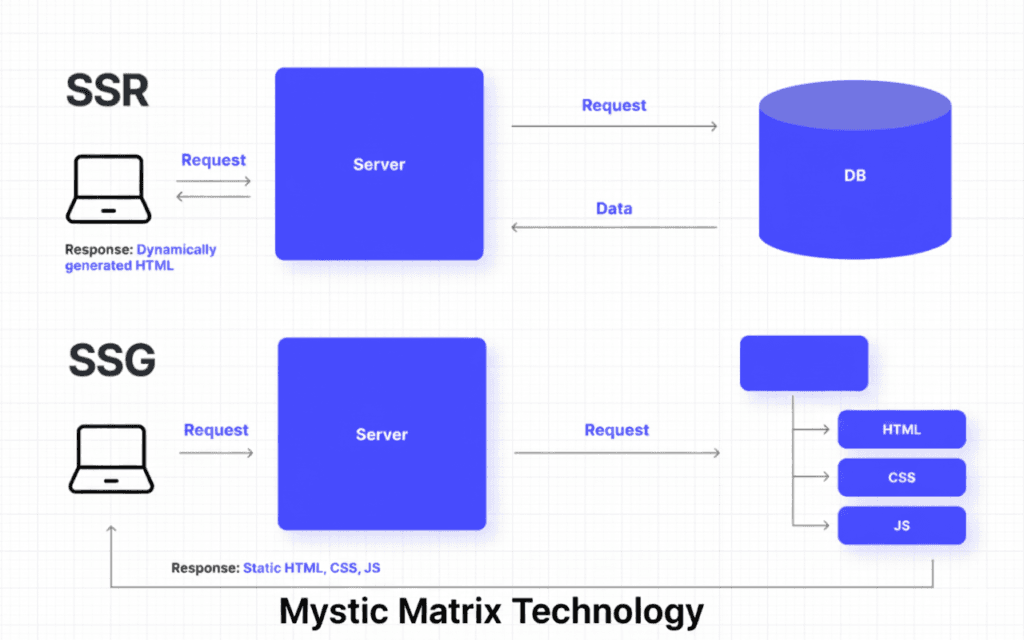
Server-Side Rendering (SSR) is the process where your webpage is generated on-demand every time a user makes a request. Instead of serving a prebuilt HTML file, the server dynamically fetches data, executes your backend logic, renders the UI, and sends the final HTML straight to the browser. This ensures that the user always receives the most up-to-date version of the application.
In 2026, SSR has undergone a significant transformation. Earlier, SSR was known to be slow or resource heavy because it required rendering everything on every request. Modern frameworks like Next.js 15, SvelteKit 2.0, Nuxt 4, and runtimes like Vercel Edge, Cloudflare Workers, and Deno Deploy have changed this dramatically. SSR now runs at the edge, meaning the rendering occurs milliseconds away from the user geographically. This reduces latency and makes SSR almost as fast as static pages — but with the benefit of real-time data.
The introduction of React Server Components (RSC) and streaming SSR enables pages to start rendering before all data is fetched, improving perceived speed. Meanwhile, AI-assisted caching systems learn usage patterns, predicting what users might request next and prefetching content intelligently.
SSR shines in applications requiring real-time updates, dynamic personalization, or secured content behind authentication. Whether it’s dashboards pulling live analytics, eCommerce platforms showing user-specific pricing, or SaaS systems with constantly changing data, SSR ensures the user always sees fresh, context-aware UI.
SSR is ideal for:
- Real-time dashboards with constantly updating metrics
- E-commerce stores with dynamic product info
- Personalized user feeds
- SaaS apps with authenticated content
- AI-driven interfaces that require per-user logic
In 2026, SSR is no longer the “slower but dynamic option”—it is now a high-speed, highly adaptive rendering model for data-rich and personalized web applications.
📄What Is Static Site Generation (SSG)?
Static Site Generation (SSG) produces HTML at build time, meaning your pages are rendered once during deployment and then served directly from a CDN as ultra-fast, prebuilt files. This makes SSG the gold standard for speed and scalability. Since the files are static, they require no server computation, making them inexpensive to host and serving almost instantaneously across the globe.
But in 2026, SSG is no longer just “static.” Modern frameworks introduced Incremental Static Regeneration (ISR), On-Demand Revalidation, and AI-powered personalization layers that allow static pages to feel dynamic without sacrificing speed. Instead of rebuilding the entire site, only individual pages or sections update when triggered.
Additionally, Partial Hydration, Resumability, and granular client-side updates mean static pages can still be interactive while keeping the initial load extremely fast. Tools like Astro, Next.js 15, and Qwik made it possible to ship almost no JavaScript initially—reducing cost, improving SEO, and delivering lightning-fast user experiences.
SSG dominates when your content changes less frequently, or when your audience is massive and performance is critical. Blogs, news portals, documentation platforms, portfolio sites, and corporate landing pages benefit most because they prioritize SEO, scalability, and low cost.
SSG remains unbeatable for:
- Marketing websites
- Blog platforms
- Documentation and knowledge bases
- Portfolio and personal sites
- High-traffic public pages
In 2026, SSG is best described as “smart static” — fast, flexible, and capable of selective real-time updates thanks to next-generation rebuild and caching systems.
⚡ The Future of Full-Stack Development: Serverless + AI-Powered Code
This shift is not just about technology — it’s about how developers work, how businesses deploy, and how clients get results faster than ever before.
👉 Learn More🛠 Real-World Use Cases in 2026
🟦 When SSR Is the Right Choice (2026 Edition)
Server-Side Rendering dominates wherever fresh data, deep personalization, and secure logic are essential to the experience. By 2026, digital platforms aren’t just delivering static content — they deliver live, adaptive, AI-enhanced interfaces. SSR has evolved into the workhorse behind apps that require millisecond-level updates, real-time decision-making, and user-specific dashboards.
One of the clearest examples is modern banking dashboards, where account balances, recent transactions, market data, fraud alerts, and credit insights must always reflect the user’s latest activity. SSR makes this possible by rendering data moment-by-moment while maintaining strict compliance, session-level authentication, and encryption. Static pages simply cannot accommodate this level of freshness or sensitivity.
Live financial markets, especially crypto trading platforms, rely heavily on SSR to stream real-time prices, volatility indicators, AI-generated trade signals, and portfolio updates. These apps must respond to global market shifts instantly, and SSR — combined with streaming and edge computation — ensures that every user sees the latest information with minimal latency.
Modern SaaS ecosystems also lean on SSR, particularly platforms focused on productivity, analytics, and operational tools. These often require dynamic charts, user-specific configurations, team-based permissions, and AI-assisted suggestions. SSR ensures that the rendered HTML reflects each user’s personalized workspace, role, data sources, and recently used apps.
Education technology has undergone a massive shift as well. Personalized learning platforms, powered by LLM tutors and adaptive lesson models, use SSR to ensure each student sees tailored lessons, spaced repetition schedules, performance graphs, and motivation nudges. SSR enables AI engines to compute what content a learner needs at that exact moment and present it instantly with real-time analytics.
Finally, AI-driven eCommerce systems depend on SSR to render personalized product recommendations, dynamic pricing models, inventory checks, promotional logic, and user-specific bundles. Retailers in 2026 rely heavily on AI to predict buying behavior, improve conversions, and adapt offerings across regions. SSR enables these hyper-personalized shopping experiences to render securely and efficiently, giving users a smooth experience across devices.
🟩 When SSG Is the Right Choice (2026 Edition)
Static Site Generation shines wherever speed, SEO, scalability, and predictable content matter most. In 2026, SSG is used by millions of sites where performance is the top priority, and real-time dynamic content is not strictly required. The strength of SSG is that it produces pre-rendered HTML, which can be distributed globally across edge CDNs, delivering instant responses regardless of user geography.
Blogs, news portals, and editorial platforms make perfect use of SSG. Content changes occasionally, not every second, and SSG paired with incremental revalidation means articles remain both fast and fresh. Modern search engines reward performance more than ever, and SSG-based sites routinely score higher in SEO rankings thanks to their lightning-fast load times. These properties make SSG the default choice for writers, creators, media teams, and publishers.
Another major area is product landing pages, where conversion rate is tied directly to page speed. Companies in 2026 use SSG to ensure landing pages load instantly, A/B test efficiently, and remain stable even when thousands of visitors arrive at once during campaigns or ad spikes. Since these pages rarely contain deeply personalized content, SSG guarantees both performance and reliability.
Technical content such as documentation portals also thrives with SSG. Developers expect stable, fast-loading docs with offline caching, structured navigation, and predictable URLs. SSG supports all of these while maintaining low maintenance overhead. Framework docs (Next.js, Astro, Angular, React), API references, and open-source libraries all rely on SSG to deliver consistent experiences.
For events, conferences, and ticketing microsites, SSG offers unbeatable scalability for periods of high traffic. Whether a site experiences 10 users or 10 million, static pages ensure zero downtime during registration waves, livestream promotions, or sale openings. With modern revalidation APIs, event organizers can update schedules, speaker details, or venue changes in seconds without rebuilding the entire site.
Finally, high-traffic marketing pages — those that need global reach, low operational cost, and maximum uptime — are ideal for SSG. These pages generally contain evergreen content, optimized CTAs, and media-rich sections that benefit from SSG’s ability to load instantly via edge delivery. With SSG, brands in 2026 ensure consistent performance across regions, devices, and network speeds.
❓ Frequently Asked Questions (FAQ)
Both are excellent for SEO, but SSG usually wins for raw speed because pages load instantly from a CDN. However, SSR is better when your SEO content needs to be updated frequently or personalized for each user.
Choose SSR when your application requires real-time data, user-specific content, authentication, or dynamic personalization. For dashboards, SaaS tools, and AI-powered recommendations, SSR delivers a much better experience than static pages.
Absolutely — SSG remains the fastest and most scalable option for blogs, landing pages, documentation, and high-traffic marketing sites. Modern SSG also supports on-demand revalidation, making it almost as dynamic as SSR.
Yes! In fact, hybrid rendering is the default approach in 2026. Frameworks like Next.js and Astro let you mix SSR, SSG, RSC, and edge rendering to optimize speed, personalization, SEO, and infrastructure costs.
SSG is typically cheaper because it serves static files from the edge with almost no server load. However, SSR becomes cost-efficient for apps requiring personalization or frequent updates since it avoids rebuilding and enables smarter caching and edge computation.