🤖 Python + LangChain: Building an AI-Powered Chatbot
The Ultimate 2026 Guide for Students, Developers & Businesses
Artificial Intelligence has officially moved beyond novelty — it is now the backbone of modern digital interaction. Whether you’re chatting with customer support, asking your banking assistant about transactions, receiving help from an online tutor, or interacting with an HR assistant at work, chances are you’re already speaking to an AI-powered chatbot. These bots are smarter, more contextual, and more human-like than ever before.
But behind every advanced conversational experience is an important question:
How do you actually build a chatbot that understands context, remembers previous conversations, retrieves accurate real-world information, and communicates like a thoughtful human assistant — not a generic script?
This is exactly where the combination of Python + LangChain reshapes the entire landscape of conversational AI.
Python remains the world’s most widely adopted language for AI development because of its simplicity, flexibility, and massive ecosystem of tools. Meanwhile, LangChain has emerged as the framework that bridges the gap between static LLMs and truly intelligent AI agents. While a standalone LLM like GPT-5.1, Claude, Gemini, or Llama 3 can generate text, it doesn’t automatically know how to:
- Maintain conversation memory
- Retrieve authoritative data from your documents
- Connect with external APIs and tools
- Perform complex reasoning steps
- Act autonomously based on context
- Adapt to user style and preferences
LangChain fills these gaps by giving LLMs memory, tools, reasoning frameworks, and structured workflows — transforming them into full-fledged AI agents.
In 2026, Python + LangChain is the most efficient way to build an AI chatbot capable of:
- Understanding conversational nuance
- Maintaining long-term user memory
- Generating context-aware responses
- Handling business-specific workflows
- Retrieving information through RAG pipelines
- Executing automated tasks, not just chatting
- Connecting to databases, APIs, PDFs, dashboards, and cloud services
This guide explores how LangChain elevates raw LLM capabilities and enables developers to create production-ready chatbots that are far more than text generators — they become reasoning assistants, research companions, workflow engines, and intelligent digital employees.
Whether you’re a student exploring AI for the first time, a developer building a real product, or a business aiming to automate support and internal operations, Python + LangChain offers the most accessible path to building a powerful AI chatbot in minutes — not months.
Let’s dive deeper into how this future-ready combination works, why it’s dominating the AI development ecosystem, and how you can start building your own intelligent chatbot today.
🧠 What Is LangChain?
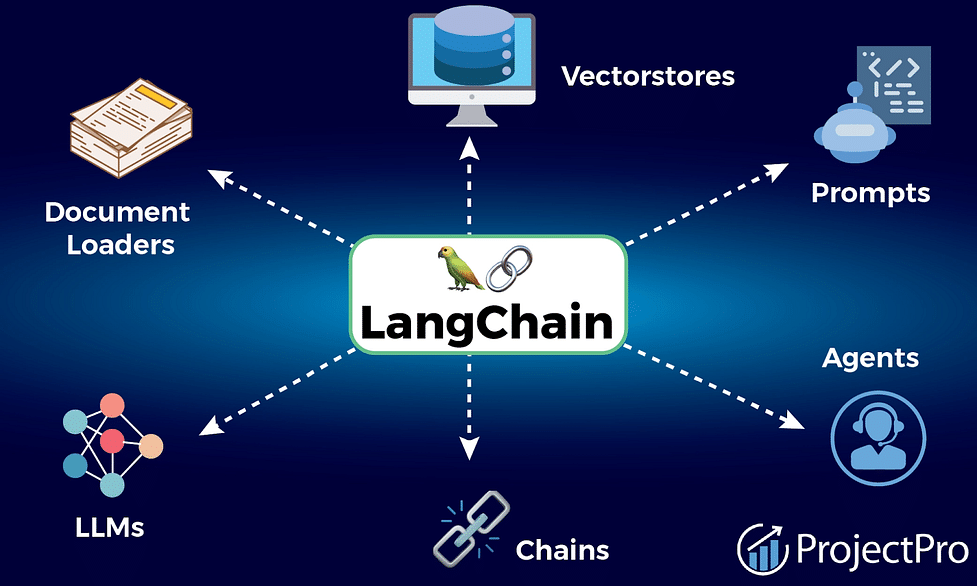
LangChain is a powerful Python framework designed to turn ordinary language models into intelligent, fully functional AI agents. While models like GPT-5.1, Claude, Gemini, or Llama 3 can generate impressive text, they still suffer from major limitations when used alone. They can’t remember long conversations, they can’t reliably access your files or databases, they can’t run tools, and they can’t reason across multi-step tasks. LangChain fixes all these gaps by acting as the “connective brain” that integrates memory, retrieval, reasoning, and tool-usage into one cohesive system.
At its core, LangChain gives LLMs the ability to operate more like real assistants. For example, a normal LLM forgets everything after a few messages, but a LangChain chatbot can maintain short-term and long-term memory, keep track of user preferences, recall past steps, and continue tasks across multiple sessions. This memory layer alone makes it dramatically more powerful than traditional chatbots.
Another major capability LangChain introduces is retrieval — the ability to connect the AI agent to real-world knowledge. Using vector databases like Pinecone, FAISS, ChromaDB, or Weaviate, LangChain can store your documents, PDFs, notes, product data, meeting transcripts, or business knowledge and fetch exactly the right information dynamically. This is the foundation of RAG (Retrieval-Augmented Generation), which modern AI systems use to eliminate hallucinations and provide accurate answers grounded in your data.
LangChain also gives LLMs the ability to use tools, something standard models cannot do alone. Through its “tools” and “function calling” system, the AI can execute Python functions, perform SQL queries, make API calls, run automation scripts, analyze documents, summarize web pages, schedule tasks, generate files, and even operate other AI agents. Instead of just talking, your chatbot can take action.
Finally, LangChain offers sophisticated agent frameworks that allow AI to break down complex tasks into multiple steps. Instead of giving a single response, agents can think, plan, research, evaluate, execute functions, and refine answers before printing the final output. This multi-step reasoning transforms LLMs from “text generators” into “problem solvers.”
In simple terms:
LLMs talk.
LangChain thinks, remembers, retrieves, and acts.
With LangChain, your chatbot no longer behaves like a static assistant — it becomes a dynamic AI system capable of real-time reasoning, contextual understanding, database-driven responses, and autonomous workflows. For students, it becomes the easiest way to build serious AI projects. For developers, it becomes the backbone of AI apps. For businesses, it unlocks powerful automation without hiring a huge engineering team.
LangChain is not just a library — it’s the engine that turns LLMs into intelligent agents.
🐍 Why Python Is the Best Choice for Building AI Chatbots (2026 Edition)
Python continues to dominate AI chatbot development for one simple reason: it strikes the perfect balance between simplicity, flexibility, and an ecosystem built specifically for machine learning. Unlike many programming languages that are powerful but difficult to learn, Python allows developers — from students to enterprise teams — to build advanced AI systems with a low barrier to entry. Its clean, human-friendly syntax means you can focus on logic and ideas instead of getting stuck on the complexity of the language itself. This is especially important in 2026, when AI development moves quickly and developers need to experiment rapidly without friction.
One of Python’s greatest strengths is its unmatched ecosystem of AI and ML libraries. Tools like NumPy, Pandas, Scikit-learn, PyTorch, TensorFlow, and JAX form the backbone of almost every major machine learning workflow. When building chatbots, developers rely heavily on data processing, model training, vector math, and neural network operations — all of which Python supports with mature, battle-tested libraries. No other language offers such a rich collection of scientific tooling, and this gives Python a massive advantage when powering intelligent conversational agents.
Python also integrates seamlessly with LangChain, the leading framework for building AI-driven agents in 2026. LangChain was designed around Python from day one, making it effortless to add features like memory, tool calling, document retrieval, RAG pipelines, multi-agent systems, and structured reasoning. For developers, this means building advanced chatbots becomes far easier in Python than in JavaScript, Rust, Java, or Go, where LangChain support is still evolving. With Python, LangChain runs natively and efficiently, allowing rapid prototyping and production deployment without switching to a different tech stack.
Another major benefit is Python’s smooth integration with vector databases — the cornerstone of modern AI chatbots that rely on retrieval-augmented generation. Whether you choose Pinecone, Weaviate, ChromaDB, Milvus, LanceDB, or FAISS, all these systems provide first-class Python SDKs that make it straightforward to store embeddings, query large datasets, and build retrieval pipelines. When a chatbot needs accurate, up-to-date information from documents, APIs, PDFs, or internal company files, Python makes the entire RAG workflow fluid, robust, and efficient.
Beyond machine learning, Python shines in backend development. Frameworks like FastAPI, Flask, and Django allow chatbot APIs to be deployed quickly with high performance and minimal overhead. FastAPI, in particular, is now the industry standard for deploying AI services because of its asynchronous design, built-in validation, and high-speed performance. This makes Python chatbots production-ready from day one, allowing businesses to integrate conversational AI directly into their websites, dashboards, internal tools, CRM systems, and cloud environments.
For beginners and students, Python offers the easiest learning journey. Its syntax feels natural, community support is enormous, and virtually every tutorial, dataset, research paper, and example code uses Python. That means students get maximum leverage from the resources available online. As AI and data science continue to grow, Python remains the language taught in universities, bootcamps, and online courses — ensuring new developers are job-ready faster.
For businesses, Python provides stability, scalability, and cost efficiency. Because Python powers major AI infrastructure at companies like Google, Meta, Tesla, OpenAI, NVIDIA, and Microsoft, it has proven its reliability at scale. Companies can build chatbots that not only converse, but integrate with databases, automate workflows, generate reports, analyze documents, provide personalized recommendations, or even orchestrate multi-agent systems — all using Python as the backbone. Python’s huge ecosystem means teams don’t waste time building tools from scratch — they simply assemble powerful components to create production-grade AI applications quickly.
In 2026, Python isn’t just a language — it’s the universal foundation for modern AI systems. It gives developers creativity, businesses reliability, and students a clear path into the world of intelligent software. When paired with LangChain, Python becomes the ultimate toolkit for building chatbots that truly understand, reason, remember, and take meaningful action.
⚙️ How LangChain + Python Power an Advanced, Human-Like Chatbot
Building a modern AI chatbot requires far more than generating text. A production-ready agent must understand user intent, remember previous interactions, access the right information at the right time, call external tools to complete tasks, and deliver consistent answers without hallucinating. This is exactly where Python and LangChain work together to create a next-generation conversational system. LangChain provides the flexible building blocks — memory, retrieval, agents, and tool integration — while Python provides the ecosystem, libraries, APIs, and execution environment that turn an LLM into a fully functional assistant. The combination transforms a raw model like GPT, Claude, or Llama into an intelligent, context-aware chatbot that can operate autonomously within real applications.
1. Conversation Memory — Giving the Chatbot a Human-Like Mind
One of the biggest limitations of raw LLMs is that they cannot remember previous messages unless the entire conversation is repeatedly stuffed into the prompt. This becomes inefficient, expensive, and difficult to scale. LangChain changes this by offering dedicated memory systems that allow a chatbot to build context over time. Python developers can easily add short-term memory that stores recent messages, long-term memory that summarizes older conversations, and vector-based memory that retrieves knowledge from past interactions. This means a chatbot no longer feels like a “reset button” every time you talk to it — it begins to behave more like a true personal assistant.
Imagine a user saying, “My name is Arjun, and I need a reminder tomorrow to submit my report.” A normal model would forget the name and the reminder within a few turns. But a LangChain-powered chatbot stores “Arjun,” the reminder, the date, and the task itself in structured memory. If the user returns hours later and asks, “What was I supposed to do tomorrow?”, the chatbot instantly pulls the saved memory and responds intelligently. Memory transforms a chatbot from a reactive tool into a persistent partner that understands who the user is and what they need.
2. Retrieval-Augmented Generation (RAG) — Connecting the Bot to Real Knowledge
Even the best LLMs sometimes invent facts — a problem known as hallucination. RAG solves this by grounding responses in real, verified data. Instead of relying solely on the model’s internal knowledge, a RAG-enabled chatbot retrieves information from external sources before generating an answer. Python, LangChain, and vector databases (such as Pinecone, ChromaDB, FAISS, Weaviate, or LanceDB) work together to store embeddings of documents, PDFs, notes, spreadsheets, policies, databases, and entire knowledge bases.
When a user asks, “What is our refund policy?”, the bot doesn’t guess. It searches the vector database, retrieves relevant text from your company’s official refund document, and uses that content to craft a precise and accurate answer. This ensures reliability and dramatically improves trust. RAG enables chatbots to become deeply knowledgeable about universities, companies, products, customers, internal systems, or personal notes — all while maintaining the conversational fluency of an LLM. In 2026, almost all enterprise chatbots use RAG as a core component because it eliminates hallucination and makes the chatbot a single source of truth for organizational knowledge.
3. Tool Calling & Actions — Turning the Chatbot Into a Real AI Worker
A chatbot that can only talk is helpful, but a chatbot that can act becomes a true assistant. LangChain’s agent framework enables LLMs to call Python functions, execute SQL queries, trigger APIs, manipulate files, generate reports, analyze spreadsheets, automate workflows, and perform real tasks on behalf of the user. This is the difference between a passive conversational model and an autonomous agent capable of completing work.
For example, when a user asks, “Show me the total revenue for last quarter,” the chatbot can connect to a SQL database, run the query, analyze the result, and present a formatted response. When a user says, “Download the latest sales report and email it to my team,” the agent can call APIs, process data, authenticate with email services, and send the message — all through LangChain’s tool-calling abilities. Python amplifies this because developers can connect virtually any library or API available in the ecosystem, giving the chatbot access to thousands of tools and real-world capabilities.
This elevates the chatbot into a fully operational digital teammate that can not only answer questions but also perform meaningful actions — whether in e-commerce, finance, HR, analytics, DevOps, marketing, or student workflows. The model becomes a multi-agent system capable of taking initiative, solving problems, and executing tasks far beyond simple conversation.
🧠 Retrieval-Augmented Generation
RAG combines the power of large language models (LLMs) with real-time information retrieval, giving AI access to fresh, verified data instead of relying solely on what it already knows.
👉 Learn More🛠️ Practical Example: Building Your First AI Chatbot Using Python + LangChain
To understand how Python and LangChain work together, let’s start with a simple but powerful real-world example. Below is a minimal chatbot that uses GPT as the language model and LangChain’s memory component to hold conversation history. This is the foundational architecture behind more advanced chatbots that include RAG, personalized memory, tool calling, and multi-agent workflows.
from langchain.chat_models import ChatOpenAI
from langchain.chains import ConversationChain
from langchain.memory import ConversationBufferMemory

llm = ChatOpenAI(model="gpt-4")

memory = ConversationBufferMemory()

chatbot = ConversationChain(
llm=llm,
memory=memory
)

response = chatbot.predict(input="Hello! Who are you?")
print(response)
This small program may look simple, but beneath the surface it demonstrates the three core pillars of modern conversational AI:
First, the ChatOpenAI model acts as the reasoning engine — interpreting user questions, generating natural responses, and maintaining a coherent tone. Second, the ConversationBufferMemory stores the conversation history, allowing the chatbot to maintain context across multiple messages. Without memory, each message would feel isolated, but with LangChain, the chatbot begins to understand continuity, identity, preferences, and conversational flow. Third, the ConversationChain brings these components together to create a functioning conversational agent.
Even though this is only a few lines of code, it becomes the foundation for building chatbots that can access documents, execute functions, query databases, call APIs, trigger automation workflows, and integrate with enterprise tools. In more advanced implementations, you can replace the buffer memory with summary memory for longer conversations, add vector memory for document-based retrieval, or integrate tool agents to turn your chatbot into an actionable assistant capable of performing tasks autonomously.
This example shows how Python + LangChain let beginners quickly build something functional while still giving developers deep scalability and control for more complex systems. You can extend this architecture into a help desk bot, personal assistant, HR chatbot, AI tutor, sales agent, or fully autonomous company chatbot — all starting from this small foundational pattern.
🟢 Why Python + LangChain Are Perfect for Students & Beginners
Python remains the most accessible programming language for students entering the world of AI. Its clean syntax, familiar structure, and enormous ecosystem remove barriers that often discourage beginners. LangChain complements this perfectly by abstracting the complex parts of LLM orchestration — meaning students can focus on building real projects rather than struggling with low-level details. This combination allows even first-year learners to build chatbots with memory, document retrieval, and reasoning capabilities without needing advanced ML knowledge.
The environment is incredibly beginner-friendly: Python integrates seamlessly with tools like Jupyter Notebook, VS Code, and Google Colab, allowing students to experiment and iterate in real time. Meanwhile, LangChain provides powerful modules for memory, agents, retrieval systems, and tool usage — giving students exposure to industry-level AI architecture. This hands-on experience dramatically strengthens portfolios and resumes, making students more competitive for internships and early career roles in AI, backend engineering, data science, or automation.
For beginners, the biggest advantage is speed: you can build a fully functioning chatbot in under 10 minutes. As your understanding grows, you can expand your project into a full-fledged system with APIs, knowledge bases, analytics integrations, and automated workflows. LangChain effectively bridges the gap between learning concepts and applying them in real-world applications. By mastering Python + LangChain, students position themselves at the forefront of one of the fastest-growing skills in the AI job market.
If you want a job in AI → learn LangChain now. It’s the new standard for building intelligent, production-ready AI systems.
❓ Frequently Asked Questions (FAQ)
LangChain gives your chatbot memory, retrieval, tool usage, and workflow automation — features raw LLMs don’t provide. It transforms a simple model into a full AI agent capable of reasoning, acting, and accessing real data.
No. Basic Python knowledge is enough to get started. LangChain abstracts most complexities, allowing beginners to build powerful chatbots within hours while learning advanced concepts gradually.
Yes. LangChain supports RAG (Retrieval-Augmented Generation), letting you connect vector databases like Pinecone, Chroma, Weaviate, or FAISS so your chatbot can answer questions using your documents and internal knowledge.
Absolutely. Many companies use LangChain for customer support bots, internal assistants, automation agents, and AI-driven workflows. It scales well and integrates with FastAPI, Flask, AWS, GCP, and enterprise systems.
LangChain works with all major models — OpenAI GPT-4/GPT-5.1, Claude, Gemini, Llama 3, Mistral, and custom fine-tuned models. You can switch models easily without rewriting your entire chatbot.