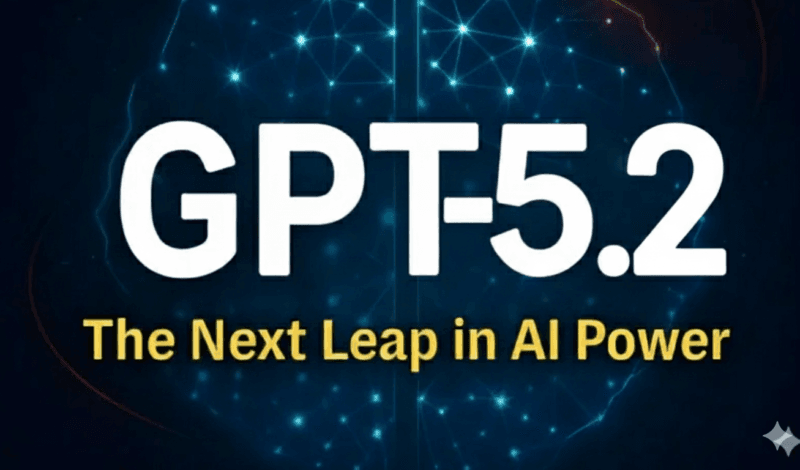
🚀 GPT-5.2 Is Here
Smarter reasoning. Faster responses. Safer AI.
The release of GPT-5.2 marks another major milestone in the evolution of large language models. While GPT-5 brought a leap in reasoning and multimodal understanding, GPT-5.2 is a refinement-focused upgrade—designed to be more reliable, more efficient, and more practical for real-world use.
This isn’t about flashy features alone. GPT-5.2 is about making AI work better for users, developers, and businesses—every single day.
🧠 What Is GPT-5.2?
GPT-5.2 is the newest refinement in the GPT-5 model family, and it represents a shift from rapid feature expansion to deep optimization, reliability, and real-world readiness. Rather than introducing a completely new interaction style, GPT-5.2 focuses on strengthening the foundations that matter most: reasoning accuracy, response stability, performance efficiency, and safety alignment. In practical terms, this means the model is better at understanding complex instructions, maintaining context across long conversations, and delivering answers that are not only fluent but also logically consistent and dependable. GPT-5.2 has been trained and tuned to reduce hallucinations, handle ambiguity more responsibly, and provide clearer step-by-step explanations when dealing with analytical, technical, or decision-heavy tasks.
Another defining aspect of GPT-5.2 is its emphasis on production-grade AI. The model is designed to perform consistently across high-load environments such as enterprise chatbots, AI copilots, internal knowledge systems, and agent-based workflows. Improvements in latency and compute efficiency make it faster and more cost-effective, especially for applications that rely on long prompts, large context windows, or frequent API calls. At the same time, GPT-5.2 includes stronger safety mechanisms, making it more resistant to prompt injection, misuse, and unintended outputs—an essential requirement for regulated industries like finance, healthcare, and education.
Conceptually, GPT-5.2 can be understood as the same powerful intelligence introduced in GPT-5, but more disciplined and refined. It doesn’t just generate answers quickly; it evaluates its own reasoning more carefully, follows constraints more strictly, and adapts better to user intent. This makes interactions feel calmer, more precise, and more trustworthy. In short, GPT-5.2 is not about reinventing AI—it’s about perfecting it. It delivers a model that is faster, safer, and more dependable, making it a strong foundation for the next generation of AI-powered products, tools, and workflows.
GPT-5.1 Is Here
Artificial Intelligence isn’t slowing down — and GPT-5.1 is proof. Instead of being a flashy “new generation” model, GPT-5.1 is a refined upgrade built on GPT-5, designed to make the AI feel more intelligent, stable, accurate and useful in real-life work — not just chat.
👉 Learn More✨ What’s New in GPT-5.2?
GPT-5.2 is not a flashy reinvention of AI—it is a deep, thoughtful refinement focused on trust, performance, and real-world usability. Each improvement targets long-standing pain points that developers, businesses, and researchers faced in earlier generations. Below is a closer look at what truly sets GPT-5.2 apart, explained in depth and with practical impact in mind.
🔍 Sharper Reasoning & Fewer Hallucinations
One of the most noticeable upgrades in GPT-5.2 is its stronger reasoning discipline. The model now handles complex, multi-step logic with greater care, significantly reducing cases where it jumps to conclusions or invents plausible-sounding but incorrect information. This improvement comes from better internal verification loops and more conservative answer generation when confidence is low. Instead of forcing an answer, GPT-5.2 is more willing to clearly state uncertainty, ask for clarification, or outline assumptions before proceeding. This makes interactions feel more transparent and human-like, especially in analytical or high-stakes scenarios.
In real-world usage, this translates to higher trust. Developers working on coding assistants see fewer broken edge cases. Researchers notice more consistent explanations that align with source material. Decision-makers benefit from answers that are grounded and cautious rather than overconfident. Over time, this reduction in hallucinations dramatically lowers the cost of human review and correction, which is critical for enterprise adoption. GPT-5.2 doesn’t just sound smarter—it behaves more responsibly when reasoning through complex problems.
Key improvements include:
- More accurate step-by-step reasoning
- Better handling of ambiguous or incomplete instructions
- Clear acknowledgment of uncertainty when data is insufficient
- Reduced generation of fabricated facts or sources
⚡ Faster, More Efficient Responses
GPT-5.2 brings meaningful optimizations at the system level, resulting in lower latency and smoother performance, even under heavy workloads. These gains are especially noticeable in long conversations, complex prompts, and real-time applications such as customer support bots or AI copilots embedded in products. The model processes context more efficiently, which means faster responses without sacrificing depth or accuracy. For end users, this feels like a more fluid, natural conversation. For developers and businesses, it directly impacts infrastructure costs and scalability.
Efficiency improvements also mean GPT-5.2 performs better in environments where speed is critical, such as live dashboards, collaborative coding tools, or voice-enabled assistants. By reducing unnecessary computation and optimizing token usage, GPT-5.2 delivers better performance per request. This allows organizations to handle more users simultaneously or run richer prompts without exponential cost increases. In short, GPT-5.2 is designed to be production-friendly, not just impressive in demos.
Key performance benefits include:
- Reduced response latency in real-time applications
- Better handling of long-context prompts
- Lower compute and operational costs
- Smoother user experience at scale
🧩 Better Context & Memory Handling
Context management has always been one of the hardest challenges for large language models, and GPT-5.2 makes a clear leap forward here. The model maintains conversational coherence across longer interactions, reducing topic drift and forgotten details. This is especially important for assistants that need to remember user preferences, prior questions, or ongoing tasks. GPT-5.2 can follow conversations that span many turns while still responding accurately to the latest input.
This improvement is crucial for modern AI architectures such as RAG systems and autonomous agents, where the model must combine retrieved knowledge with ongoing context. GPT-5.2 integrates information more smoothly, making it better at synthesizing documents, tracking goals, and maintaining consistent tone and intent. The result is an AI that feels less forgetful and more attentive, capable of acting as a reliable assistant rather than a short-term responder.
Key context-handling upgrades include:
- Improved long-conversation stability
- Less context loss in multi-turn dialogues
- Stronger integration with RAG and memory systems
- More consistent behavior across extended workflows
🛡️ Stronger Safety & Alignment
Safety and alignment are at the core of GPT-5.2’s evolution. The model has been reinforced to better resist prompt injection, manipulation attempts, and misuse. It follows system and developer constraints more reliably, which is essential for regulated environments such as healthcare, finance, education, and enterprise software. GPT-5.2 is also more consistent in applying content policies, reducing unexpected or unsafe outputs while still remaining helpful and informative.
From an organizational perspective, this stronger alignment reduces legal and reputational risk. Teams can deploy GPT-5.2 with greater confidence, knowing that it is less likely to generate misleading advice, inappropriate content, or policy-violating responses. For users, this means clearer boundaries and more predictable behavior. GPT-5.2 strikes a better balance between usefulness and responsibility, making it a safer foundation for large-scale, real-world AI systems.
Key safety enhancements include:
- Improved resistance to prompt injection attacks
- More reliable adherence to policy constraints
- Reduced generation of unsafe or misleading content
- Greater suitability for enterprise and regulated use cases
🚀 Introducing GPT-5.2
GPT-5.2 is the most advanced frontier model designed for professional-grade work and long-running autonomous AI agents, setting a new benchmark for reasoning, reliability, and real-world deployment.
👉 Read the Official OpenAI Announcement🔁 GPT-5 vs GPT-5.1 vs GPT-5.2
| 🔍 Capability / Feature | GPT-5 | GPT-5.1 | GPT-5.2 |
|---|---|---|---|
| Core Focus | First major leap in GPT-5 series | Stability & reasoning improvements | Reliability, performance, and enterprise safety |
| Reasoning Accuracy | High logical reasoning | Higher consistency in multi-step logic | Highest — more structured, cautious, and precise |
| Hallucination Control | Moderate (can over-guess) | Improved factual grounding | Significantly reduced hallucinations, admits uncertainty |
| Instruction Following | Good | Very good | Excellent — follows complex, layered instructions |
| Speed & Latency | Good for most tasks | Better response times | Optimized for real-time apps & long conversations |
| Long-Context Handling | Strong | Stronger | Most stable — minimal context drift |
| Multi-Turn Conversations | Can lose older context | Improved memory flow | Highly consistent across long dialogues |
| RAG & Knowledge Integration | Works well with RAG | Better retrieval alignment | Best for RAG pipelines & enterprise knowledge systems |
| Coding & Technical Tasks | Strong code generation | Better debugging & refactors | More reliable, fewer logical/code errors |
| Decision Support & Analysis | Useful but verbose | More structured responses | Clearer, safer, and more trustworthy analysis |
| Safety & Alignment | Baseline safety controls | Stronger policy adherence | Most aligned — better prompt-injection resistance |
| Enterprise Readiness | Medium | High | Very high — ideal for regulated industries |
| Best Use Cases | General AI tasks | Production chatbots & copilots | Enterprise AI, agents, healthcare, finance, research |
| Overall Maturity | Powerful but evolving | More refined | Most production-ready GPT-5 model |
👨💻 How GPT-5.2 Benefits Everyday Users
For everyday users, GPT-5.2 delivers a noticeably more refined and trustworthy experience compared to earlier versions. The biggest change users feel is not just intelligence, but judgment. GPT-5.2 is more confident in areas where it has strong knowledge, yet far more careful when information is uncertain. Instead of guessing or over-explaining, it now pauses, clarifies assumptions, and provides balanced responses. This makes interactions feel calmer, more human, and less chaotic. Whether a user is asking for help with studies, planning a career move, managing daily tasks, or exploring new ideas, GPT-5.2 responds with clearer structure and intent-aware guidance.
Another major improvement is how well GPT-5.2 understands why a user is asking something. It can infer intent from partial instructions, conversational tone, or follow-up questions without constantly needing clarification. This is especially valuable for non-technical users who may not phrase prompts perfectly. In writing tasks, GPT-5.2 produces more coherent drafts, improved flow, and fewer logical inconsistencies. In learning scenarios, explanations are more step-by-step, grounded, and adaptive to the user’s level of understanding. Planning tasks such as travel, finances, or schedules benefit from better reasoning and fewer contradictory suggestions.
Most importantly, GPT-5.2 feels safer and more reliable. Users are less likely to encounter misleading information, exaggerated claims, or confident-but-wrong answers. This makes it suitable not only for casual use, but also for sensitive contexts such as education, personal decision-making, or professional communication. Overall, GPT-5.2 shifts the user experience from “impressive but unpredictable” to “powerful and dependable.”
Key user benefits at a glance:
- More accurate and grounded explanations
- Better understanding of user intent and context
- Reduced hallucinations and reckless answers
- Improved writing quality and logical flow
- Safer, calmer, and more trustworthy interactions
🧑💻 How Developers Can Use GPT-5.2 Effectively
For developers, GPT-5.2 represents a significant step forward in building production-grade AI systems. One of the most immediate benefits is improved reliability in code-related tasks. GPT-5.2 generates cleaner code, follows language-specific best practices more consistently, and makes fewer logical mistakes during refactoring or optimization. When debugging, it is better at identifying root causes instead of suggesting superficial fixes. This saves developers time and reduces the need for repeated prompt corrections.
GPT-5.2 also excels in backend and system-level use cases, especially when deployed via APIs. It performs exceptionally well as the reasoning engine behind AI agents, copilots, and automation workflows. Developers building Retrieval-Augmented Generation (RAG) systems will notice fewer false answers and better alignment between retrieved documents and generated responses. This is critical for enterprise knowledge bases, internal tools, legal documents, and customer-support bots where accuracy matters more than creativity.
Another key advantage is how well GPT-5.2 integrates into modern AI stacks. When combined with vector databases such as Pinecone, ChromaDB, or Weaviate, the model maintains context more effectively across long sessions. When used with agent frameworks like LangChain, CrewAI, or AutoGen, GPT-5.2 handles multi-step reasoning, tool calling, and decision branching with greater stability. It is also optimized for serverless and edge deployments, making it suitable for low-latency applications like real-time copilots, IDE assistants, and AI-driven dashboards.
From a business and engineering perspective, GPT-5.2 reduces operational risk. Fewer hallucinations mean fewer safeguards need to be layered on top. Better instruction adherence means simpler prompt design. Improved efficiency means lower compute costs at scale. All of this makes GPT-5.2 not just a smarter model, but a more economical and production-ready one.
Key developer advantages at a glance:
- More reliable code generation and refactoring
- Stronger debugging and technical reasoning
- Better performance in RAG and agent-based systems
- Seamless integration with vector databases and frameworks
- Lower risk, lower cost, higher production stability
❓ Frequently Asked Questions (FAQ)
GPT-5.2 focuses on stability, accuracy, and safety rather than radical interface changes. It significantly reduces hallucinations, improves reasoning, and delivers more reliable responses, especially for professional and enterprise use cases.
GPT-5.2 benefits both. Everyday users get clearer, more trustworthy answers, while developers gain a more stable model for coding, RAG systems, agents, and production-grade AI applications.
Yes. GPT-5.2 has improved long-context handling and maintains conversation flow more accurately, making it ideal for assistants, chatbots, and multi-step reasoning workflows.
The model is better aligned with policy constraints, admits uncertainty when needed, and avoids guessing. This results in fewer misleading or overconfident responses, especially in sensitive domains.
Absolutely. Its improved reliability, lower error rates, and better performance in API-based systems make GPT-5.2 well-suited for enterprise deployments in healthcare, finance, education, and SaaS platforms.