🎨 AI in Non-Tech Domains: How Music, Art & Writing Are Being Transformed in 2026
Not replacing creativity — expanding it.
Artificial Intelligence is often viewed through a tech-heavy lens: code, data, cloud, automation, cybersecurity.
But the real revolution happening in 2026 is not only in tech — it’s in creative industries.
AI is now composing music, generating artwork, writing fiction, designing graphics, producing videos, and even collaborating with humans on creative decision-making. Instead of replacing artists, AI is reshaping what creative work looks like, making imagination limitless and creativity more accessible.
This is the rise of Human + AI Collaboration, not Human vs AI.
🌟AI in Music — A New Era of Creativity & Collaboration
The music industry in 2026 is experiencing its biggest transformation since the invention of digital audio workstations.
AI is no longer just a tool — it has become a creative collaborator capable of composing melodies, arranging harmonies, generating beats, and producing studio-quality soundscapes in seconds.
Modern AI music models like Sunno, AIVA, Udio, and Google MusicLM have pushed the boundaries of what non-musicians and professional producers can achieve. These systems analyze patterns from thousands of songs, learn musical structures, and generate original compositions across genres: EDM, orchestral, hip-hop, jazz, or ambient.
What makes AI revolutionary in music is not just its speed but its ability to adapt to the artist’s intention. A musician can describe a vibe — “soft acoustic, melancholy mood, warm guitar plucks” — and AI instantly generates a perfect starting point. Instead of spending hours experimenting, creators now explore dozens of ideas effortlessly. This drastically shortens the creative cycle and expands the range of sounds possible.
AI is also democratizing music production. Beginners who have never touched a DAW can now create professional-level tracks simply by describing what they want. Meanwhile, experienced producers use AI for arrangement ideas, chord progressions, mixing assistance, and mastering suggestions. Instead of replacing musicians, AI acts as a co-composer, helping them break creative blocks and reach new sonic territories.
🎧 Real-World Example: Speeding Up Music Production
Imagine a music producer trying to build a soundtrack for a short film. Traditionally, they would spend hours composing, layering, and mixing. Now the workflow looks like this:
A producer hums a simple melody →
AI instantly converts it into a fully orchestrated cinematic theme →
The producer fine-tunes emotion, pacing, and instrumentation →
AI automatically mixes and masters the track.
What used to take days can now be done in 30 minutes.
This human-AI loop is becoming the new industry standard, allowing creators to focus more on storytelling and emotion rather than mechanical production tasks.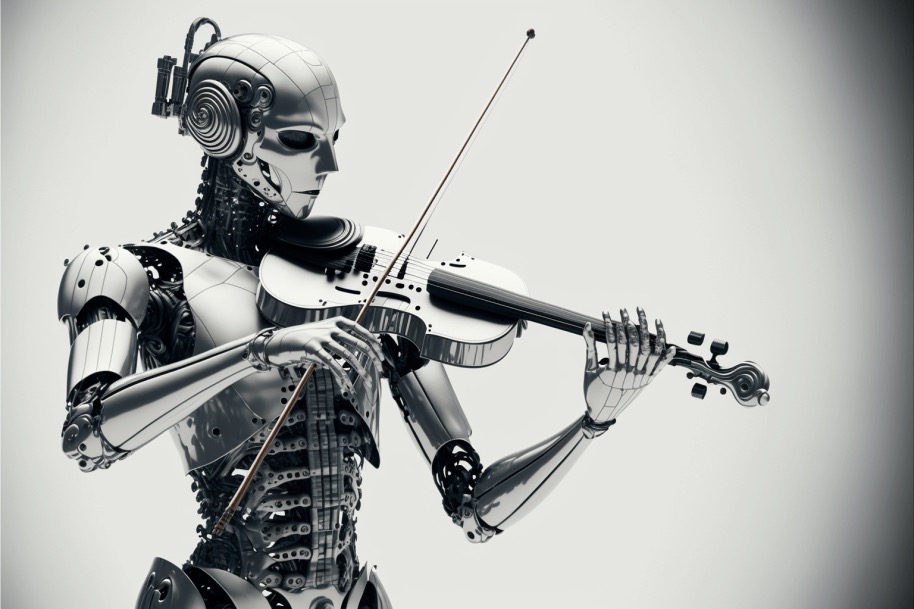
🎨AI in Art — Visual Imagination Without Limits
Visual art is entering a renaissance powered by AI, where creativity moves at the speed of thought.
AI image models like Midjourney, Stability XL, Adobe Firefly, and DALLE-3 allow artists to generate digital paintings, concept sketches, hyper-realistic renders, and even full 3D compositions with a single sentence. This sudden expansion of capability has not only boosted productivity but also unlocked entirely new styles and workflows.
AI tools are now deeply integrated across industries. In film and animation, AI helps creators storyboard complex scenes, design characters, or generate cinematic lighting references within seconds. In gaming, studios use AI to create environments, texture maps, weapon skins, and atmospheric effects without requiring massive artist teams. In fashion and interior design, AI rapidly prototypes outfit ideas, room layouts, furniture concepts, and color palettes. Even the world of NFTs and digital galleries has exploded thanks to AI-generated artworks that push the boundaries of imagination.
One of the most profound benefits is idea exploration. Artists no longer need to manually craft each version of a concept. They can sketch a base form, feed it into an AI model, and generate dozens of variations — each exploring shape, mood, texture, and perspective differently. This accelerates experimentation and gives artists more time to refine the emotional story behind the artwork.
🖼 Human–Machine Collaboration Example: Creative Synergy
A designer begins with a simple rough sketch of a futuristic vehicle.
They upload it to an AI tool.
Within seconds, AI generates 20 fully rendered concepts with different lighting setups, color schemes, textures, and angles.
The designer selects the best direction, makes manual refinements, and adds narrative elements.
The result is not AI replacing the designer — but AI amplifying the designer’s imagination.
Humans set the vision.
AI expands the possibilities.
Together, they achieve results that neither could accomplish alone at the same speed or scale.
✍️AI in Writing - Creativity Supercharged & Reimagined
Artificial Intelligence has quietly become one of the most transformative tools for writers across every industry. What started as simple autocomplete suggestions has evolved into powerful writing companions like GPT-5.1, Claude Opus, Gemini Pro, and Llama 3, capable of generating stories, analyzing tone, improving clarity, and even helping writers think.
In 2026, AI in writing isn’t just about speed — it’s about amplifying human imagination. Writers no longer face blank pages alone. AI can assist with brainstorming ideas, generating outlines, refining voice, expanding chapters, correcting grammar, improving pacing, or researching complex topics. Instead of doing the heavy mechanical work, humans can focus on emotional storytelling, theme, originality, and nuance — the elements machines still cannot fully replicate.
🔍 How AI Enhances the Creative Writing Process
AI tools act as a creative companion that supports the full lifecycle of writing.
A writer begins with a rough concept — maybe a single sentence describing a character or conflict.
AI expands this into a chapter outline.
The writer then edits, adds emotional depth, refines character motivations, adjusts tone, and injects personality.
AI steps back in to polish grammar, fix inconsistencies, enhance flow, and improve readability.
This back-and-forth collaboration mirrors the relationship between an author and an editor — except the editor is available 24/7, responds instantly, and offers hundreds of variations to explore.
For novelists, AI helps with world-building, character arcs, plot branching, and pacing analysis.
For students, it helps with summaries, concept explanations, essay structure, and research notes.
For marketers, AI generates engaging content for social media, blogs, email campaigns, and sales pages.
For screenwriters, AI can generate scene descriptions, dialogues, and storyboards.
For business writers, it helps with clarity, tone optimization, report generation, and document structuring.
✨ The Real Magic: Human–AI Collaboration
The most powerful writing workflows today follow a simple loop:
Humans generate emotion → AI expands → Humans refine → AI polishes → Humans finalize.
This creates a synergistic cycle where the writer’s creativity meets the AI’s generative speed.
AI does not replace the writer’s soul, intuition, or narrative feel — it simply accelerates the repetitive steps so writers can invest energy into what truly matters: meaning, message, and human connection.
📚 Real-World Example: Novel Writing With AI
Imagine a novelist writing a fantasy book:
They draft a chapter idea about a hero exploring an ancient temple.
AI instantly expands it into a detailed version with atmospheric descriptions, dialogue options, and plot twists.
The writer then injects emotion, trauma, humor, and subtle character cues that AI alone could not produce.
Finally, the AI edits for pacing, consistency, grammar, and structural flow.
What used to take 3–4 weeks may now take 3–4 days — without sacrificing quality.
Writers maintain the emotional core.
AI enhances the execution.
✏️ AI for Blog Writing — A Massive Boost for Content Creators
In the blogging industry, AI has become a standard tool used by professionals, editors, content creators, agencies, students, and businesses. AI helps writers:
generate topic ideas
research trends and keywords
outline articles
draft long-form blogs
improve readability and SEO
rewrite or enhance tone
condense or expand content
create social media snippets
Bloggers no longer need to struggle with starting points or structure.
AI can produce a fast draft so the writer can focus on creativity, storytelling, and personal voice.
For website owners and companies, AI ensures content output stays consistent and high-quality — even when deadlines are tight
🤝Human–Machine Collaboration — The Creative Studio of the Future
By 2026, the partnership between humans and AI has evolved into one of the most powerful creative forces of our time. AI tools no longer compete with artists, designers, musicians, or writers. Instead, they act as hyper-intelligent collaborators that expand what humans can create. The creative studio of the future is no longer a room filled only with designers and editors — it is a hybrid ecosystem where AI handles the heavy lifting while humans focus on emotional depth, originality, and vision.
AI accelerates production by managing tasks such as rough drafts, resizing assets, transcription, style exploration, background generation, and structural editing. Humans then add storytelling, nuance, cultural understanding, and personal expression. This co-creation workflow dramatically shortens production cycles while enhancing the quality and consistency of the final output.
A New Creative Feedback Loop
The modern creative workflow now operates through a continuous loop:
Human → AI → Human → AI,
where each step improves the previous one. A designer might start with a rough sketch. AI transforms it into 20 polished variations. The designer then refines the best idea. AI helps enhance colors, lighting, or composition. Finally, the human finishes the piece with personal flair.
This iterative loop brings experimentation to a level that was previously impossible. Creativity becomes faster, deeper, and more exploratory. Ideas that once took days now take minutes. Artists can explore multiple directions without worrying about cost or time, making creativity more playful, bold, and expressive.
The Rise of Collaborative AI Studios
Creative teams are now building multi-agent AI pipelines that mirror the real creative departments found in film, gaming, design, and marketing studios. Instead of assigning tasks to different employees, organizations now assign them to dedicated AI agents:
One AI generates story concepts.
Another creates visual scenes or illustrations.
A third AI generates voice lines or music.
A fourth agent edits, enhances, or assembles the content.
A human creative director then combines everything and finalizes the piece.
This structure allows small teams and startups to produce Hollywood-quality work with limited budgets. AI democratizes production by giving individuals and small businesses access to tools that once required entire departments and million-dollar setups.
🏢How Businesses Use AI Across Creative Industries
AI has shifted from being a novelty to a core driver of revenue, efficiency, and innovation. Industries that traditionally relied on large creative teams — like marketing, film, game development, education, and retail — are now using AI to reduce costs, accelerate delivery, and explore new creative possibilities. The impact is both financial and strategic: companies can produce more content, at higher quality, in less time, and with fewer resources.
AI in Marketing & Branding
Brands now use AI tools to generate ad concepts, taglines, email campaigns, social media posts, and promotional graphics at scale. AI can instantly analyze audience behavior, recommend messaging styles, and even adjust visuals based on target demographics. This personalized creativity leads to higher engagement and dramatically faster turnaround times.
AI in Film & Video Production
Filmmakers rely on AI to pre-visualize scenes, generate complex VFX drafts, create character designs, and even assist in video editing. AI helps storyboard directors test camera angles, environments, and lighting before production begins, saving time and reducing costs. Tools like Sora, Runway, Pika, and Adobe Firefly now support everything from cinematic shots to full animation sequences.
AI in Gaming & CGI
The gaming industry uses AI to generate 3D assets, environment concepts, non-playable character dialogue, level variations, and procedural animations. AI accelerates asset creation, allowing game designers to focus on gameplay, storytelling, and player experience. AI-generated graphics and textures also reduce development bottlenecks.
AI in Education & E-Learning
Textbooks, interactive lessons, illustrations, and student-personalized learning modules are now created using AI. Teachers save enormous time on content creation, while students benefit from tailored explanations, custom exercises, and adaptive storytelling.
AI in Real Estate, Retail & E-Commerce
AI produces virtual interior designs, 3D models, product photos, catalog descriptions, UI images, ad creatives, and promotional videos. Businesses can update product visuals instantly, run A/B tests on creative elements, and automate entire seasonal campaigns with minimal human involvement.
AI’s creative reach continues to expand — and it now sits at the heart of business strategy, innovation, and product development.
👩🎓How Students & Clients Can Use AI Creatively
Students today have access to tools that past generations could only dream of. They can compose music without instruments, design characters without learning 3D modeling, write stories without facing writer’s block, and generate art without formal training. AI lowers the barrier to entry, making creativity accessible to anyone with curiosity and imagination.
Students use AI to create portfolios for design schools, generate artwork for personal brands, craft resumes, write essays, storyboard videos, and produce concept art for game design projects. With AI, a student can produce an entire animated short film, complete with sound design, background art, and dialogue — all from a laptop.
Clients Benefit From Speed, Quality and Scalability
Clients use AI to generate content for marketing, branding, social media, web design, product launches, and even business pitches. AI allows them to create high-quality visuals, ads, and promotional materials instantly — without needing to hire a full creative team.
❓ Frequently Asked Questions (FAQ)
No. AI accelerates production and explores variations, but humans still provide originality, emotional depth, cultural understanding, and storytelling. AI is a creative assistant — not a replacement.
Start with beginner-friendly tools: Canva AI for design, Suno/Udio for music, ChatGPT/Claude/Gemini for writing, and Midjourney/DALL·E for art. Experiment with small projects and build skills through consistent practice.
Yes — as long as you use licensed tools and understand their usage rights. Always check terms before publishing or selling AI-generated content, especially in commercial or client projects.
Blend human input with AI assistance: start with your ideas, let AI generate variations, and refine the final output yourself. Add personal emotion, cultural context, and human judgment to avoid generic results.
Use trusted AI platforms, avoid uploading sensitive data, validate outputs manually, and ensure materials don’t infringe on existing works. Combine AI tools with clear governance and human oversight.