🛡️ AI-Driven SOCs
Security Operations Centers were once designed to be command rooms where analysts manually reviewed alerts, investigated incidents, and responded to threats one case at a time. This model worked when infrastructure was limited, threats were relatively slow-moving, and data volumes were manageable. However, the digital landscape has transformed dramatically. Organizations today operate across multi-cloud environments, SaaS platforms, remote endpoints, and API-driven architectures that generate massive amounts of security telemetry every second. Traditional SOC models were never designed to operate at this scale or speed.
Modern enterprises now face millions of security events every single day, most of which are noise, duplicates, or low-value alerts. At the same time, cybercriminals have adopted automation, AI, and ransomware-as-a-service models, enabling them to launch large-scale, coordinated, multi-stage attacks in minutes rather than days. Cloud workloads spin up and down dynamically, identities are constantly changing, and attack surfaces expand continuously—creating an environment that human-led SOC teams cannot realistically monitor manually.
Compounding the problem is a global shortage of skilled cybersecurity professionals. SOC analysts are overworked, under-supported, and forced to triage endless alerts while trying to meet strict compliance requirements. Burnout is widespread, investigation backlogs are common, and organizations are increasingly exposed to delayed detection, incomplete investigations, and missed threats. Meanwhile, breach costs and regulatory penalties continue to rise, turning security into both a financial and reputational risk.
This combination of volume, velocity, complexity, and talent scarcity has made the traditional SOC model unsustainable. A fundamentally new approach is required—one that operates at machine speed, scales effortlessly, and continuously learns.
AI-Driven SOCs represent this next generation of security operations. Instead of relying on human analysts to manually chase alerts, AI systems continuously ingest and correlate telemetry across endpoints, networks, identities, and cloud workloads. They distinguish real threats from noise, automatically investigate incidents, generate complete attack narratives, and either recommend or execute response actions in seconds. Over time, these systems learn from every attack and response, becoming smarter and more precise.
The SOC is no longer just a monitoring room—it becomes an autonomous cyber defense engine capable of protecting modern enterprises in real time.
🧠 What Is an AI-Driven SOC?
An AI-Driven Security Operations Center is a fundamentally new security model where artificial intelligence becomes the primary engine for detection, investigation, prioritization, and response. Instead of relying on human analysts to manually triage endless streams of alerts, AI-driven SOCs use machine learning, behavioral analytics, and automated reasoning to continuously monitor and defend digital environments at machine speed. The SOC evolves from a reactive operations room into a living cyber defense platform that operates autonomously and improves itself over time.
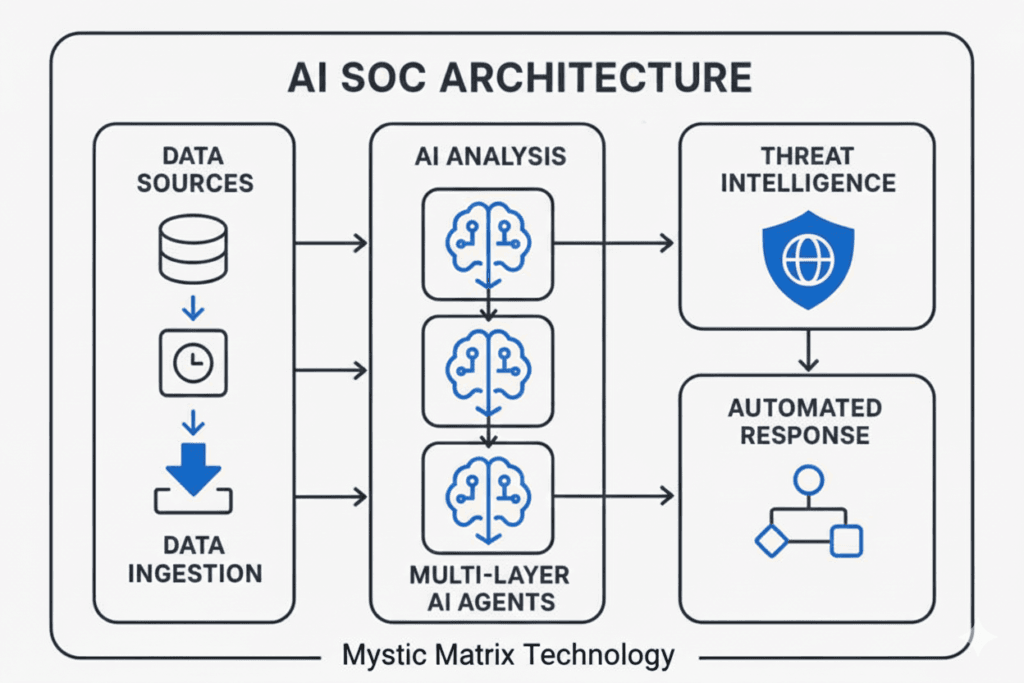
At the core of an AI-driven SOC is a continuous intelligence loop. AI models ingest telemetry from endpoints, networks, identity systems, applications, APIs, and cloud workloads. They correlate thousands of weak signals across these layers to detect real threats that would otherwise remain hidden in noise. Unlike traditional rule-based systems that depend on known signatures, AI-driven SOCs identify abnormal behavior, emerging attack patterns, and zero-day threats by understanding how systems normally behave and flagging deviations in real time.
When a threat is detected, AI systems automatically reconstruct the entire attack story. They trace lateral movement, privilege escalation, data exfiltration attempts, and command-and-control communication without human intervention. The SOC produces a complete incident narrative within seconds—something that traditionally takes analysts hours or days.
Response is also transformed. AI-driven SOCs can recommend remediation actions or execute them autonomously based on predefined confidence thresholds. These actions may include isolating endpoints, disabling compromised accounts, blocking malicious IPs, rolling back configuration changes, or triggering incident response workflows. Each response feeds back into learning loops, allowing the system to refine future detections and responses continuously.
The result is a SOC that no longer operates as a ticket-handling center but as an intelligent, self-improving cyber defense engine capable of stopping attacks in real time.
Key Highlights
- Machine-speed detection across endpoints, cloud, identities, and networks
- Behavioral analytics to identify unknown and zero-day threats
- Automated attack investigation and timeline reconstruction
- Autonomous or guided response action
- Continuous learning from every incident
- SOCs become intelligent cyber defense platforms
🔐 Cybersecurity for Generative AI Systems
As generative AI models become deeply integrated into products, businesses, and public systems, the challenge is no longer just about making them smarter — it’s about keeping them safe.
👉 Read More⚠️ Why Traditional SOCs Are Failing
Traditional Security Operations Centers were designed for an era when infrastructure was static, threats evolved slowly, and security telemetry volumes were manageable. SOC workflows were built around manual alert review, static detection rules, and linear investigation playbooks. Analysts could realistically examine alerts, correlate logs manually, and respond within acceptable timeframes. This model depended on human judgment as the primary detection and response engine.
Today’s digital environments look nothing like that past reality. Modern enterprises generate millions of security events per day across endpoints, SaaS platforms, APIs, cloud workloads, identity systems, and networks. Attackers no longer rely on single-step exploits; they deploy automated, multi-stage attack chains that unfold in minutes—using credential theft, lateral movement, data exfiltration, ransomware payloads, and evasion techniques in rapid succession. Cloud workloads spin up and down continuously, identities change dynamically, and network boundaries have all but disappeared.
At the same time, the cybersecurity workforce is under extreme strain. Skilled analysts are scarce, expensive, and burned out. Teams struggle to keep up with alert queues, incident investigations, compliance reporting, and threat hunting—all while trying to respond faster than automated attackers. This creates chronic backlogs, delayed responses, missed detections, and rising breach risk. The traditional SOC has become a bottleneck rather than a defense engine.
Manual SOCs can no longer scale with the speed, complexity, and volume of modern cyber threats. Without automation and intelligence, organizations remain reactive, overwhelmed, and exposed.
Key Highlights
- Millions of daily alerts overwhelm human analysts
- Attack chains are automated and multi-stage
- Cloud environments change continuously
- Analyst shortages increase security risk
- Manual SOC workflows cannot scale
⚡ How AI Changes Security Operations
AI introduces a new operational paradigm that transforms security from reactive monitoring into predictive, autonomous defense. Instead of waiting for known signatures to trigger alerts, AI-driven SOCs continuously analyze behavioral patterns across the entire digital environment. Machine learning models establish baselines of normal activity and detect deviations that indicate emerging threats—often before damage occurs. This allows organizations to predict attack paths and intervene early.
AI also transforms raw alerts into intelligence. Thousands of weak, fragmented signals are automatically correlated into unified attack narratives that show how an incident unfolded, what systems are affected, and what actions should be taken. This eliminates manual correlation work and drastically shortens investigation time.
Response workflows are no longer limited to static playbooks. AI-driven SOCs can automatically execute containment actions such as isolating compromised endpoints, revoking credentials, blocking malicious traffic, and rolling back configurations in seconds. These responses are guided by confidence thresholds and continuously improved through learning loops.
Finally, AI introduces continuous learning into security operations. Models evolve as attackers change tactics, techniques, and procedures. The SOC becomes a self-improving defense platform rather than a static rule-based system.
Key Highlights
- Predictive detection of emerging threats
- Automated correlation of fragmented alerts
- Machine-speed containment and remediation
- Continuous learning from new attack patterns
- SOCs evolve into autonomous defense engines
🧩 Core Capabilities of AI-Driven SOCs
| Capability | Strategic Value It Delivers |
|---|---|
| Behavioral Intelligence | Continuously analyzes user, device, and network behavior to detect unknown threats, zero-day attacks, insider risks, and stealthy lateral movement patterns that signature-based tools miss. |
| Automated Threat Triage | Instantly filters millions of daily alerts, suppresses noise, prioritizes true incidents, and routes only critical threats for action—eliminating analyst overload. |
| Autonomous Incident Investigation | Automatically reconstructs complete attack chains, timelines, affected assets, root causes, and blast radius within seconds—without human correlation. |
| Machine-Speed Response Orchestration | Executes isolation, credential revocation, traffic blocking, configuration rollback, and remediation workflows in seconds—stopping attacks before damage spreads. |
| Predictive Threat Modeling | Forecasts attack paths, identifies weak points before exploitation, and proactively prevents breaches rather than reacting to them. |
| Self-Learning Defense Systems | Continuously adapts detection models and response logic based on live attack behavior, improving security posture automatically over time. |
🏢 Where AI-Driven SOCs Are Already Dominating
AI-driven SOCs are no longer experimental — they are actively redefining security operations across some of the world’s most sensitive and high-risk industries. Financial services organizations use AI-driven SOC platforms to detect fraud patterns, prevent ransomware campaigns, and protect real-time payment systems that cannot afford downtime. These institutions process millions of transactions per hour, and even a few seconds of delayed response can result in massive financial losses and regulatory exposure. AI enables instant detection of anomalous behavior, automated containment, and continuous compliance validation.
Healthcare providers rely on AI-driven SOCs to safeguard patient data, connected medical devices, and clinical systems. With the rapid expansion of digital health platforms, telemedicine, and IoT medical devices, attack surfaces have grown exponentially. AI continuously monitors these environments, identifies abnormal access patterns, prevents data exfiltration, and ensures compliance with healthcare privacy regulations — while allowing clinicians to focus on patient care rather than security operations.
SaaS and cloud providers depend on AI-driven SOCs to monitor multi-tenant environments at scale. These platforms must detect threats across thousands of customer environments simultaneously, isolate compromised tenants instantly, and prevent lateral movement across shared infrastructure. AI-driven SOCs provide automated correlation, isolation, and remediation across dynamic workloads without impacting legitimate customers.
Government agencies use AI-driven SOCs for national cyber defense, election security, and critical infrastructure protection. These environments face persistent advanced threats from nation-state actors, requiring continuous intelligence analysis, predictive threat modeling, and autonomous response capabilities.
Manufacturing organizations protect industrial control systems (ICS), operational technology (OT), and smart factory networks using AI-driven SOCs. These environments cannot tolerate downtime, and AI-driven systems prevent sabotage, ransomware, and equipment tampering in real time.
E-commerce platforms rely on AI-driven SOCs to secure digital payments, protect identities, prevent account takeover attacks, and ensure transaction integrity during peak traffic periods.
These environments demand absolute speed, precision, and zero tolerance for breaches — making AI-driven SOCs not optional, but essential.
Key Highlights
- Protects financial, healthcare, SaaS, government, OT/ICS, and e-commerce systems
- Enables real-time threat detection and automated containment
- Supports compliance-driven industries with continuous validation
- Scales across high-volume, multi-tenant and mission-critical systems
🔮 The Future: Autonomous Cyber Defense
The next generation of SOCs will evolve into autonomous cyber defense platforms that continuously protect, optimize, and harden enterprise environments without waiting for human intervention. These systems will self-monitor security posture across cloud, endpoint, network, and identity layers, continuously analyzing exposure, misconfigurations, and risk signals.
They will predict vulnerabilities before attackers exploit them by simulating attack paths, identifying weak points, and proactively applying mitigation strategies. Misconfigurations will be patched automatically, risky access privileges will be revoked, and security controls will be optimized in real time. Incident response will become autonomous — with machine-speed containment and remediation occurring the moment threats appear.
These systems will also integrate global threat intelligence and continuously learn from emerging attack patterns, enabling defenses to improve automatically. The SOC will transform from a reactive operations center into a continuously evolving security intelligence engine.
💡 Why AI-Driven SOCs Are Becoming Mandatory
The modern cyber battlefield has fundamentally changed. Attackers are automated, coordinated, and increasingly AI-powered themselves. Enterprise environments are dynamic, decentralized, and constantly changing. Skilled cybersecurity talent is scarce and expensive, and compliance requirements continue to grow in both scope and complexity.
Manual security operations cannot scale to meet this reality. Human-led SOCs simply cannot keep up with machine-speed attacks, cloud-native architectures, and continuous digital transformation. AI is no longer a feature — it has become the foundational layer of modern cyber defense.
Organizations that fail to adopt AI-driven SOCs will operate with increasing blind spots, slower response times, and growing breach exposure. Those that do will gain resilient, adaptive, and autonomous cyber defense systems capable of protecting modern digital enterprises at scale.
Key Highlights
- Attackers operate at machine speed
- Enterprise environments change continuously
- Cybersecurity talent is scarce
- Compliance pressures are increasing
- AI becomes the foundation of modern cyber defense
❓ Frequently Asked Questions (FAQ)
A traditional SOC relies on human analysts to manually review alerts and respond to incidents. An AI-Driven SOC uses machine learning and automation to detect, investigate, and respond to threats in real time—reducing noise, accelerating response, and continuously improving defenses.
No. AI does not replace humans—it amplifies them. AI handles high-volume detection, triage, and response, allowing security teams to focus on strategic threat hunting, governance, and complex investigations.
Yes. AI-Driven SOCs are especially valuable in regulated industries like finance, healthcare, and government because they provide stronger audit trails, faster incident response, and continuous compliance monitoring.
AI-Driven SOCs can detect, investigate, and contain many threats in seconds—far faster than manual workflows that often take hours or days.
They are highly effective against ransomware, account takeovers, insider threats, lateral movement attacks, phishing campaigns, and zero-day exploits by detecting behavioral anomalies rather than relying solely on known signatures.