

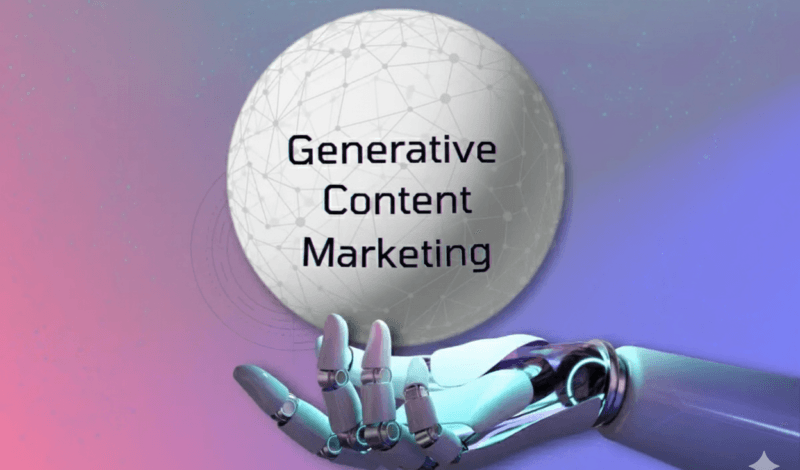
🚀 Generative Content Marketing
Content has always been the backbone of digital marketing — blogs, emails, ads, videos, landing pages, and social media posts drive brand visibility, trust, and conversions. But as digital channels multiplied and customer expectations grew more personalized, traditional content creation models started to crack.
Marketing teams are now expected to produce more content, for more channels, more frequently, and with deeper personalization — often with the same or smaller budgets.
This pressure gave rise to a powerful new approach:
Generative Content Marketing.
AI is no longer just a productivity tool — it is becoming a creative engine that helps brands design, generate, personalize, and optimize content at scale.
🧠 What Is Generative Content Marketing?
Generative Content Marketing is a modern marketing approach where artificial intelligence becomes an active creative engine rather than just a productivity assistant. It leverages advanced AI technologies — including large language models, multimodal generation systems, and real-time learning algorithms — to automatically create, personalize, and optimize marketing content across every digital channel. Instead of relying solely on manual writing and editing cycles, marketing teams now orchestrate intelligent systems that continuously generate high-quality content at speed and scale.
In this model, content is no longer static. AI dynamically adapts messages based on brand tone guidelines, customer behavior patterns, real-time intent signals, and the specific context of each channel or funnel stage. Emails adjust based on customer actions, ad copy evolves based on performance, landing pages personalize themselves for each visitor, and blog content updates as search trends change. Performance feedback loops allow the system to learn which versions convert best — and automatically generate stronger variations.
This fundamentally transforms marketing from a manual production pipeline into an automated creative intelligence engine — where content is not just created, but continuously learned, refined, and optimized.
Key Takeaways
- AI becomes a creative engine, not just a writing tool
- Content dynamically adapts to user behavior and intent
- Personalization scales automatically across channels
- Performance feedback loops continuously optimize messaging
- Marketing evolves from manual creation to intelligent automation
🔍 How the Google Search Algorithm Works
Google Search is powered by hundreds of ranking signals and intelligent systems that determine what content deserves to be seen first. This guide explains the logic, behavior, and hidden mechanics behind how Google understands, ranks, and surfaces the web.
👉 Read Full Breakdown⚡ Why Traditional Content Marketing Is Breaking
Traditional content marketing was built for a slower digital world — a world where monthly campaigns, static landing pages, and occasional blog posts were enough to drive engagement. Today, however, digital markets operate in real time. Customer behavior changes by the hour, competitors launch campaigns instantly, and social platforms continuously reshape content visibility algorithms. Yet many marketing teams are still dependent on slow, manual production workflows that cannot keep pace with this environment.
Content creation remains labor-intensive, expensive, and heavily dependent on limited human bandwidth. Personalization — which modern customers now expect — becomes nearly impossible to scale manually across thousands or millions of users. Marketing teams struggle to test enough creative variations, leading to under-optimized campaigns and missed revenue opportunities. Campaign performance often lags behind market behavior, and by the time results are analyzed, customer intent has already shifted. Over time, creative teams experience fatigue, leading to declining quality and reduced experimentation.
AI fundamentally changes this model by turning content into a living, self-optimizing system. Instead of creating fixed campaigns, marketers deploy intelligent engines that continuously generate, test, personalize, and improve content in real time — allowing brands to respond instantly to market dynamics and customer needs.
Key Takeaways
- Traditional workflows cannot keep up with real-time marketing demands
- Manual personalization does not scale effectively
- Limited creative testing reduces conversion optimization
- Campaigns lag behind changing customer behavior
- AI enables continuous, automated content optimization
🤖 What AI Changes for Marketers
Generative AI fundamentally transforms how marketing teams operate by becoming a continuous creative co-pilot rather than a one-time content tool. Instead of relying solely on human effort to write, test, and refine campaigns, marketers now work alongside intelligent systems that can generate, personalize, and optimize content in real time. AI can instantly produce blogs, emails, advertisements, social captions, landing page copy, video scripts, and campaign messaging — dramatically accelerating content production without sacrificing quality.
More importantly, AI personalizes messaging automatically based on audience segments, customer intent, browsing behavior, and funnel stage. It can generate hundreds of creative variations in seconds, allowing teams to run large-scale A/B and multivariate testing that would be impossible manually. Tone, style, and messaging adapt dynamically to audience preferences and brand voice guidelines. Performance feedback loops ensure that high-converting content is identified and strengthened, while underperforming versions are automatically improved or retired. Multilingual generation further enables brands to expand globally without building new creative teams.
This shifts marketing from a linear “create → publish → wait” cycle into a continuous creative intelligence system — where content evolves in real time, campaigns self-optimize, and marketers focus on strategy rather than production.
Key Takeaways
- AI acts as a real-time creative co-pilot
- Content generation, personalization, and testing are automated
- Campaigns adapt dynamically to user behavior
- Performance feedback loops continuously improve messaging
- Marketing becomes a living, self-optimizing intelligence engine
🧩 Advanced Capabilities of Generative Content Marketing
| Capability | What It Enables |
|---|---|
| Dynamic Copy Generation | Automatically adapts messaging based on real-time user intent, device, location, and behavior |
| Creative Variation Engines | Instantly generates hundreds of copy versions for multivariate testing at scale |
| Funnel-Aware Content Intelligence | Delivers the right message for awareness, consideration, and conversion stages |
| Multichannel Content Orchestration | Synchronizes campaigns across web, email, ads, social, SMS, and in-app channels |
| Multilingual & Localization AI | Creates region-specific, culturally adapted messaging instantly |
| Performance Learning Loops | Continuously learns which content converts and self-optimizes future messaging |
| Behavioral Personalization | Adjusts copy based on user browsing, purchase history, and engagement patterns |
| Conversion Probability Modeling | Predicts which message will convert before publishing |
| Brand Voice Governance | Enforces tone, compliance, and style automatically |
| SEO & Discoverability Optimization | Dynamically improves keywords, metadata, and structure for search engines |
| Offer & Pricing Personalization | Customizes promotions and pricing copy in real time |
| Campaign Auto-Refinement | Automatically retires weak creatives and amplifies high-performing ones |
| Journey-Based Content Mapping | Aligns messaging to multi-step customer journeys |
| Content ROI Forecasting | Predicts performance impact before launch |
🏢 Where Generative Marketing Is Dominating
Generative content marketing is rapidly becoming the growth engine behind the world’s most competitive digital businesses. In SaaS companies, AI-powered content systems personalize onboarding emails, feature announcements, churn prevention messaging, and in-app prompts — significantly improving trial-to-paid conversions and customer lifetime value. E-commerce brands use generative marketing to dynamically generate product descriptions, promotional emails, ad creatives, and landing pages tailored to individual shopper behavior, browsing patterns, and purchase intent. This enables personalized experiences at massive scale while increasing conversion rates and reducing cart abandonment.
Performance advertising teams leverage AI to generate and test hundreds of creative variations across paid search, social, and display channels, allowing campaigns to continuously optimize based on real-time performance feedback. Email and lifecycle marketing teams use generative systems to automate drip campaigns, nurture sequences, and re-engagement flows that adapt dynamically to each user’s stage in the customer journey. SEO teams rely on AI to scale high-quality content production, optimize keywords, generate meta content, and maintain consistent search visibility across thousands of pages. Influencer and social marketing campaigns are also becoming increasingly automated, with AI generating captions, scripts, and campaign concepts aligned with platform trends and audience sentiment. For brands expanding globally, localization and internationalization become frictionless as generative systems produce culturally adapted content in multiple languages instantly.
In every one of these areas, revenue growth now depends on speed, personalization, and continuous testing — making generative marketing not just an advantage, but a competitive necessity.
🔮 The Future: Self-Optimizing Marketing Systems
The future of marketing is moving toward fully autonomous, self-optimizing intelligence engines. Instead of launching static campaigns, organizations will deploy systems that predict which content will convert before publishing, dynamically adapt messaging in real time based on audience behavior, and automatically generate new creative variations to replace underperforming ones. These systems will continuously learn customer intent patterns, refine personalization models, and optimize entire conversion funnels without human intervention.
Marketing will evolve from a campaign-driven activity into a living intelligence engine — one that senses behavior, reasons about performance, and adjusts itself continuously to maximize growth. Teams will shift from creating content manually to supervising, governing, and strategically guiding autonomous marketing systems.
Key Takeaways
- Marketing engines will predict conversions before launch
- Messaging will adapt dynamically in real time
- Creative systems will generate and replace content automatically
- Customer intent will be learned continuously
- Marketing becomes autonomous, adaptive, and self-optimizing
❓ Frequently Asked Questions (FAQ)
No. Generative AI does not replace marketers — it amplifies them. AI handles repetitive content creation, testing, and optimization, while humans focus on brand strategy, creativity, governance, and growth planning. Marketers become creative system designers rather than manual content producers.
Yes, when properly governed. Modern generative systems include brand voice controls, compliance filters, approval workflows, and explainable performance tracking — ensuring all content remains aligned with brand, legal, and ethical standards.
AI models analyze user behavior, preferences, device context, and funnel stage to dynamically generate tailored content for each audience segment or individual — automatically adapting tone, offers, and messaging in real time.
Absolutely. Cloud-based generative marketing platforms make enterprise-grade personalization, automation, and testing accessible to startups and SMBs without large teams or budgets.
The biggest advantage is continuous optimization. Campaigns evolve automatically based on performance feedback, enabling faster growth, better conversion rates, and more efficient marketing spend.



Comment (1)
Great content! Keep up the good work!